
Your Ancestors Don't Need You to Grieve Quietly. An ode to celebrating Indigenous Peoples Day and how BIPOC Cultures grieve outside of colonization.
Someone in your family might have told you to be strong at the funeral when you were younger. Perhaps it was your auntie who placed her hand briefly on your shoulder before she turned back to the guests. Or maybe it was your mom running throughout the house since dawn, arranging food, greeting people, and holding everything together that from afar, it seemed like she wasn’t grieving at all. Perhaps it was a message that wasn’t spoken but felt, you know the way silence shifts when someone’s sorrow becomes much... You could sense the room change when crying lingered too long and when the expression of grief reached unspoken boundaries.
You absorbed something at that funeral, not through direct teaching but by observing how the adults navigate through their feelings in real time. Children pick up the most important lessons this way. You realized grief has a certain volume it’s allowed to reach before it becomes a problem. The women in your family were tasked with maintaining that volume, and this effort was equated with being strong, which in turn was synonymous with love, but at what cost?
The Grief That Was Taken Before It Could Be Felt
As we reflect on Indigenous Peoples’ Day, we are confronted with the ongoing reality of what has been taken from the original inhabitants of this land. How we grieve and who shaped our grieving practices isn’t just an abstract historical inquiry. It relates to what you feel in your body right now.
From studies I’ve read and from conversations I’ve had with Indigenous Native Americans, there’s a continued existence of grief among Indigenous Native Americans that span generations, a grief deeper than any single loss. This grief is so foundational that it predates living memory. It encompasses the loss of practices, the severing of languages, and the erosion of mourning traditions systematically dismantled through displacement, forced assimilation, and federal policies meant to erase the ways their people traditionally mourned.
Indigenous peoples of North America specifically (only speaking to America because of national holiday but recognize this statement to extend outside of America, naturally) had mourning practices that viewed grief as a communal experience. These rituals were ceremonial and unfolded over time. They didn’t rush resolution or pathologize prolonged sorrow. Instead, they centered the entire community around the process of grieving rather than burdening the bereaved to navigate it alone. I want to provide an example of what this looks like. Reservation Dogs is a show about indigenous adolescents living on a reservation in Oklahoma and their community. There’s an episode of an elder, one of the main character’s grandmothers on her death bed. The community came together in the home as she took her last breath, taking turns to be with her, and share the communal grief. If you haven’t seen the show, I deeply encourage you to watch the series.
Did you know that mourning ceremonies were criminalized under the Indian Civilization Act and other federal policies. The boarding school system forcibly separated children from their families, severing the intergenerational knowledge that would have guided them in mourning. The pain of that severance is still present. It lives on in descendants reclaiming their heritage, discovering that returning to ceremony isn’t nostalgia but a form of healing. It resides in Native women who were raised with the directive to be strong, who absorbed that lesson through the same familial silence we began with. They didn’t realize that behind that silence was a living tradition that had been actively and systematically taken away.
The notion of being strong that was pressed onto your shoulder at the funeral didn’t originate with the women who communicated it, no. It continues to travel through generations of women who had to maintain composure because their reality required it. Composure and capability were necessary for survival.
We must no longer survive but thrive in our culture and when specifically speaking on Native Americans I want to support the culture and normalize their cultural and spiritual practices within the clinical space.
Don’t Appropriate
It’s important to clarify something, the grief stemming from severed lineages and the desire to reconnect with ancestral practices can lead women to make a mistake that should be addressed….
Returning to your own lineage isn’t the same as borrowing from another.
If your lineage is Indigenous to a specific nation and you’re learning its mourning practices with guidance from its living community, that’s reclamation. Those ceremonies, songs, and specific rituals that your ancestors carried are yours to rediscover, regardless of how imperfect your path may be.
However, adopting the ceremonial practices of an Indigenous nation that isn’t yours especially those still actively preserved by communities that endured centuries of persecution is cultural appropriation. Even with good intentions, it causes harm. On this day, when we remember what was taken from Indigenous people, we should be cautious not to continue the cycle of taking. Practices like smudging, sweat lodges, and specific prayers of nations whose children were removed from their families aren’t available for casual appropriation, because we don’t do that in this space.
If you’re not Native but are drawn to Indigenous ceremonies, the invitation isn’t to take but to explore what in your own lineage may still be waiting for you to rediscover. Every colonized lineage had mourning practices before colonization. Every community silenced from speaking to their dead had been doing so long before suppression took hold.
Your ancestors are ready to guide you back to the traditions of your own people. You don’t need to step through someone else’s doorway.
The Ancestors Aren’t Waiting for You to Have It Together
In my sixteen years of doing spiritual work, I’ve learned that ancestors aren’t waiting for you to reach a certain level of spiritual sophistication before they connect with you. They don’t hold off on reaching out until you’ve built the right altar or learned the proper prayers. They’re interested in establishing relationships, and that connection can begin from wherever you are, with whatever you have.
Research on continuing bonds in grief has shown since the 1990s that people maintain meaningful connections with those who have passed. These connections manifest in ways that differ from the simplistic images of spirituality. They can appear in dreams that carry a unique message. They may also show up in body memory such as when you cook a familiar recipe and suddenly sense knowledge from your grandmother’s hands, or when you step into a particular landscape and recognize something you can’t consciously recall.
They arrive as repeated signs: a certain bird appearing at just the right moment, a song playing as you face a significant choice, or a familiar scent wafting in without a source, immediately recognized as belonging to a deceased loved one. These experiences are reported across cultures and among people with varying degrees of spiritual belief, including both devoutly religious individuals and skeptics.
Societal norms often state that grief should be contained and private. Speaking to the dead out loud in front of others is deemed inappropriate, embarrassingly primitive, or a sign of unresolved emotions. Yet your lineage the part untouched by suppression understands this behavior differently.
You have permission to speak to them. You can speak their names aloud and feel the impact of doing so.
Three Ways In
You don’t need to start by creating an elaborate ancestral altar or conducting a formal ceremony. Reconnection can begin small, and often these smaller steps prove to be more authentic than grand rituals, which can sometimes become performative rather than genuine.
1.
You might begin by learning one more name from your ancestry than you currently know. Whatever name represents the furthest ancestor you recognize, seek out the next one. Ask the oldest family member available or explore any existing records, even if they’re incomplete or difficult. Find that name, say it aloud, and feel the weight of having acknowledged someone who has previously gone unnamed in your presence. If the records are non-existent and names were lost, articulate what you do know instead. You might say: I call in the women of my lineage who crossed the water, or the ones whose names I don’t know but whose blood lives in me. An open call can be just as powerful as a specific one sometimes even more so, as it acknowledges what has been taken.
2.
Consider cooking a dish that traveled through your family. This week, prepare it with the intention of connecting, not just for nourishment. Allow the act of cooking to become a conversation. As you work with your hands, recognize that they’re building on the knowledge passed down from other hands. The kitchen has historically been a space where ancestral knowledge survived even amid suppression. They could take the prayers, but the memory associated with food transcended the bounds.
3.
You could also set a simple offering of water and a candle. A clean glass of water alongside a candle on any surface you use with intention does not appropriate anyone’s specific tradition. Water offerings are a universal gesture across cultures, acknowledging that the dead may thirst. Offering water communicates care: I remember you, I honor you, and I recognize that your existence made mine possible.
Light the candle and speak to whoever comes to your mind in whatever language feels right. Say: I am here. I am thinking of you. Come if you are willing. Then take a moment to sit quietly, noticing whatever arises, without attempting to evaluate its significance as it comes.
Text within this block will maintain its original spacing when published
Which grief did the women before me never get permission to feel, and am I willing to feel it for them now?
Let this resonate in your body before you translate it into words. Write from where it settles not from the part of you that can present grief nicely, but from the part that has held something on behalf of your lineage longer than you’ve had a name for it.
Additional Resources
🍂 The Elements of Grief Course opens October 25th
A self-paced psychospiritual course moving through Earth, Water, Air, Fire, and Spirit as frameworks for the full complexity of grief, including the ancestral grief this post touched. The waitlist is open now and cart opens in two weeks.
🎓 The Psychospiritual Grief Method Training is this Saturday, October 17th
For clinicians ready to bring this framework into their practice with the clinical rigor and spiritual literacy the work actually requires. Six CE credits, small cohort, last call for registration.
🌿 The Grief Sanctuary
For the women who want to keep going after today. The Grief Sanctuary provides weekly Thursday content of psychospiritual content that will include a ritual, meditation, and or journal prompt. This is where the ongoing practice lives.
📞 Grief Counseling Consultation is free and available for California residents seeking individual grief counseling inside a framework that was built to hold all of what they are carrying.
With care + intention,
Amber

Your Grief Training Was Built for White Clients and Your BIPOC/BBIA Clients Can Tell
Culturally Neutral Grief Care Isn’t Neutral and the Clients Who Notice First Are the Ones Who Stop Coming Back.
She brings up, during one of the later sessions, that her grandmother has been appearing in her dreams. It’s not just a symptom she’s reporting; it’s something she’s sharing intentionally, gauging your reaction as she speaks to determine if this setting is safe for her to be honest. You notice her observing you, subtly trying to find a way to fit her experience into a clinical framework with what she’s feeling.
She notices everything. Every time something similar surfaces in her grief, she’ll likely hold back from discussing it with you again.
This scenario highlights a gap in the training that many clinicians receive. It’s not an isolated incident; it’s happening in therapy rooms across the board, especially for BIPOC/BBIA women who are often left carrying the weight of their grief into spaces that were never designed to accommodate its entirety.
Where Our Dominant Grief Models Actually Come From
The well-known stage model of grief created by Kübler-Ross, which has shaped clinical training for many years, was based on discussions with terminally ill patients during the late 1960s in a predominantly white, Western, and Christian medical context. It was never meant to be a universal guide for how people experience loss, yet it became one. The underlying perspective of detachment, viewing loss as an individual psychological occurrence with acceptance as the ultimate goal, permeated clinical training without critical examination on how it would impact different cultures.
Bowlby's attachment theory also influenced the understanding of bereavement, suggesting that healthy grieving involves gradually letting go of the bond with the deceased. Nope, we’re not teaching this are we? Within an individualistic and secular framework, the deceased is seen as definitively lost, while continued attachment is viewed as a failure to adapt rather than a culturally significant ongoing relationship.
These models weren’t designed to address communal grief, ancestral loss, or the kind of grief that sees death as a threshold instead of an ending. They don’t account for grief intertwined with spirituality or collective experiences. Instead, they emerged from specific cultural assumptions about grief and what constitutes healthy mourning. Clients who arrive with different worldviews often try to fit themselves into a framework that doesn’t serve them or leave when the effort to adapt outweighs the support they receive.
The Losses That Never Get Named in Session
Disenfranchised grief refers to feelings of loss that the broader culture fails to recognize. BIPOC/BBIA clients frequently carry this grief, yet clinical training often lacks the vocabulary to address it, leaving them to navigate sessions with feelings unrecognized and unnamed.
One example is continues to occur is the physiological impact of chronic exposure to racial stress, as highlighted by researcher Arline Geronimus. Black women may grieve for their health and wellbeing which is something that should still be viable for us, but there’s no clinical term for this grief. It doesn’t come with a funeral or a defined moment of loss; instead, it accumulates silently within the body along with other burdens.
Then there’s the grief stemming from medical neglect and racism. A woman who was ignored for years before finally receiving a diagnosis grieves not just her health but also the lost time and trust. These losses often go unnamed in clinical settings.
Community grief manifests in watching neighborhoods change, communities disperse, or children growing up disconnected from cultural roots. This collective sorrow lacks recognition in a culture that doesn’t provide rituals to contain it. In BIPOC/BBIA communities, pregnancy and infant loss carries the additional pain of medical racism, as disparities in how Black maternal pain is treated compound the grief with a sense of rage that finds no outlet in standard grief frameworks.
Ancestral and cultural grief is another layer, rooted in histories of slavery and colonization. It encompasses the loss of traditions, languages, and knowledge systems without opportunity for closure. This grief doesn’t start with a specific personal loss; it’s an ever-present weight carried within the body and the patterns of life.
None of these losses are adequately addressed by dominant grief models. Clients sense this absence from the very beginning of therapy.
What Happens When Spirituality Isn’t Explored
There exists a form of cultural competence that encourages clinicians to acknowledge a client’s spiritual beliefs, only to set them aside during the clinical work. Although the intention behind this is positive, the outcome is often exclusionary. By sidelining the client’s spiritual life, the clinical space inadvertently communicates that the core of how they understand death and loss falls into an area which is either uncomfortable or unknowledgeable to explore.
For a Black woman whose grandmother visits her in dreams, this isn’t just a symptom of grief. It reflects a persistent connection, a relationship with the deceased that her cultural background recognizes as both valid and beneficial. Research by Klass, Silverman, and Nickman since 1996 has shown that maintaining such connections is a facet of healthy grieving, contrary to earlier models that pathologized it.
When clinicians ignore this experience, clients feel pressured to reshape their grief into language that fits the room’s parameters, a translation that comes at a cost. Every time they do this, they lose a part of themselves, and in time, this diminishes the therapeutic relationship because the version of themselves that they bring to sessions is too constrained to tackle the work they seek to accomplish.
What Decolonized, Culturally Centered Grief Care Actually Looks Like
The ARISE Arc, central to the Psychospiritual Grief Method, evolves from the understanding of these challenges rather than simply adding on to existing frameworks that were never meant to encompass them.
Acknowledge means naming the full scope of the loss, including the losses that have no funeral and no cultural recognition and no clinical category, and the grief that is ancestral and inherited and communal as well as personal, and the spiritual experiences that are arriving in the grieving person's life and asking to be received rather than assessed.
Reconnect means returning the client to the relational and spiritual resources her grief has disrupted or obscured, including her ancestral lineage, her cultural practices, the continuing bond with the person she lost, and the community context that most individualist grief models have never included as a clinical resource, and this reconnection is somatic as well as relational, working with grief where it actually lives in the body, in the specific locations where loss is stored and where survival patterns have calcified, using practices drawn from the client's own cultural and ancestral tradition to reach what cognitive processing alone cannot touch.
Integrate means holding the grief inside the full story of who the client is, including her lineage and her identity and her spiritual framework, rather than treating it as a psychological event to be processed in isolation from the rest of her life.
Sustain means building the ongoing practices, relationships, and spiritual structures that allow the integrated self to remain in contact with her grief, her lineage, and her healing without requiring constant acute intervention, creating a sustainable relationship with loss rather than a finished resolution of it.
Emerge means the self that surfaces on the other side of the work, a self that is not defined only by the loss but informed by it, carrying what the grief has taught and what the ancestors have offered into a life that is genuinely different from the one that existed before the loss, and genuinely livable.
This is what culturally centered grief care embodies. It’s not more challenging than the training most clinicians have received; it just requires more than what we’ve been taught. The training on October 17th offers practitioners the chance to bridge that gap.
Join the Training Before Seats Close
On Saturday, October 17th, 2026, the Psychospiritual Grief Method training titled Grief, Disenfranchised Loss, and Culturally Centered Care for BIPOC Clients will take place. This six-hour live session grants six CE credits. It’s designed for clinicians who have felt the disconnect between their training and the needs of their clients, ready for a rigorous framework that can address these issues.
This isn’t a cultural sensitivity webinar or a lecture on demographics. It’s a comprehensive methodology training led by a Black, LPCC, and evidential medium who has developed this framework through years of both clinical and spiritual work with BIPOC/BBIA women.
Seats are limited and filling. This is the week to register.
🎓 The Psychospiritual Grief Method Training is on Saturday, October 17th, 2026, 6 hours, 6 CE credits.
🍂 The Elements of Grief Course opens October 25th, a self-paced psychospiritual course for women who to work more with their grief through elemental themes.
🌿 The Grief Sanctuary for women seeking ongoing community and monthly psychospiritual grief support that holds the cultural, ancestral, and spiritual dimensions of their experience.
📞 Grief Counseling Consultation is free and available for California residents seeking individual grief counseling inside a framework that was built to hold all of what they are carrying.
With care and intention,
Amber
I Went to Paradise and Still Couldn't Find Myself There
I went from flying home today, landing in tomorrow, just to arrive in yesterday.
I recently spent ten days in Bali, and I feel compelled to share my honest experience because isn’t seen through the photos I’ve captured.
On the surface, it appeared to fulfill every wish a weary healer might have. The Goddess Retreat in Ubud, Bali resort provided wholesome Indonesian cuisine and fresh juices each morning, unlimited massages (which I truly enjoyed), and I spent the week with aligned women for a week, what could be so bad? This was my sister’s trip that I decided to hop on earlier this year. Initially believing that I had nothing to heal from well…. That was the greatest deception I faced this year… Did I heal? Was I revitalized? Well…
Initially, I didn’t feel rejuvenated. Anxiety kept me away from the present moment even in beautiful spaces which I hated. I struggled to be present when I was in a place of relaxation. While lying on a massage table or sitting with a group of joyful women, a part of me would drift away, scanning, planning, and bracing for an overarching concern. Although I was physically in paradise, emotionally I felt detached, observing my own experience rather than truly engaging with it.
If you’ve ever gone on a vacation, scheduled a retreat, or finally allowed yourself some rest only to feel an unsettling disconnect, you’re not alone. As both a clinician and a woman who experienced this halfway across the globe, I understand. Places are avenues for escape and although I was not going on vacation to escape, I was hoping that anxiety would be less present. This time it showed up in a way that was foreign. It didn’t look the same. No tightness in my chest, no struggling to fall asleep, not even racing thoughts per se. This time anxiety looked like fear of the unknown, or something that had nothing to do with my present moment. It felt like I was outside of my body looking at my experience from third person… also known as depersonalization, this was new for me.
The moment I felt the water's touch
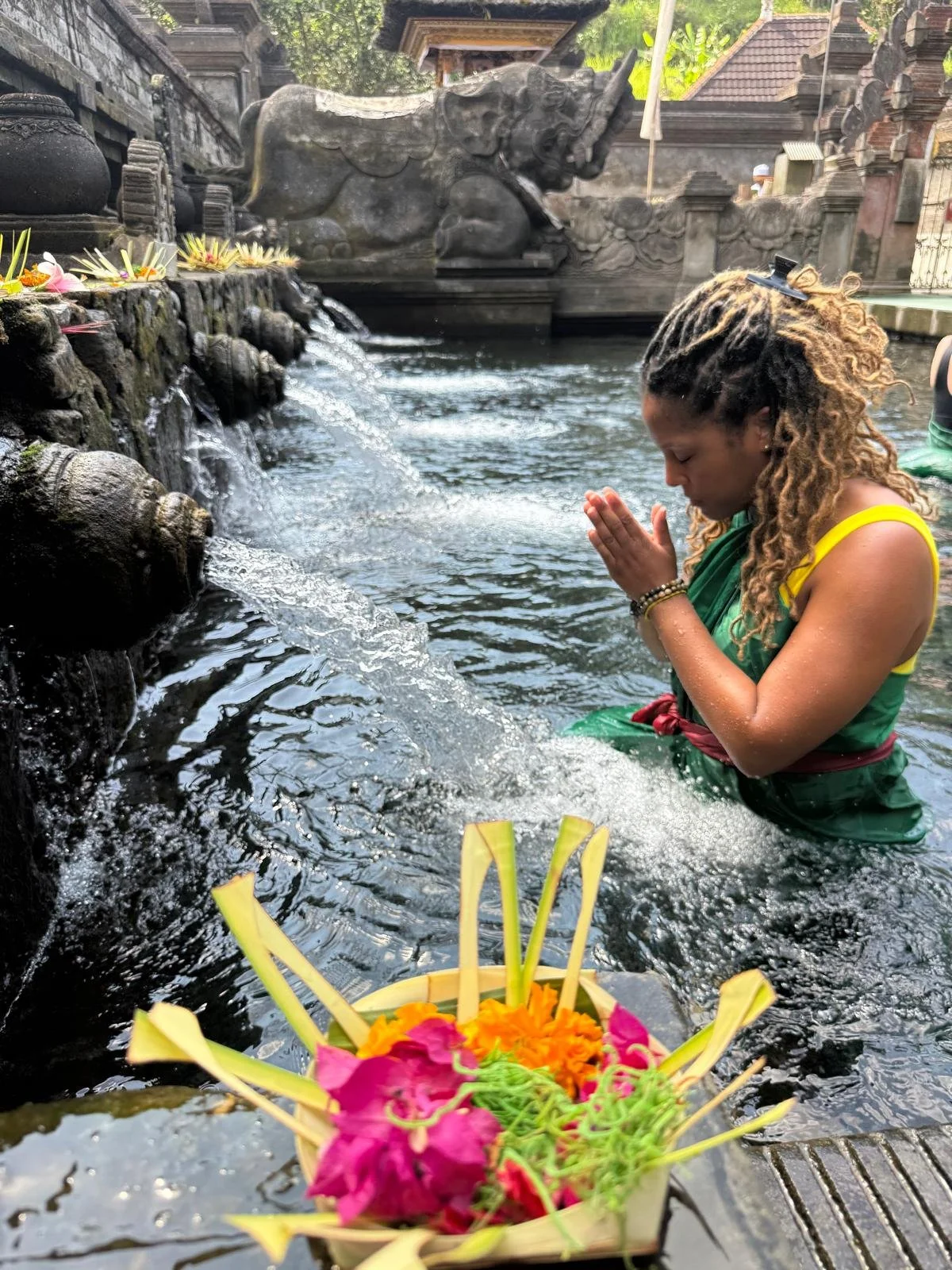
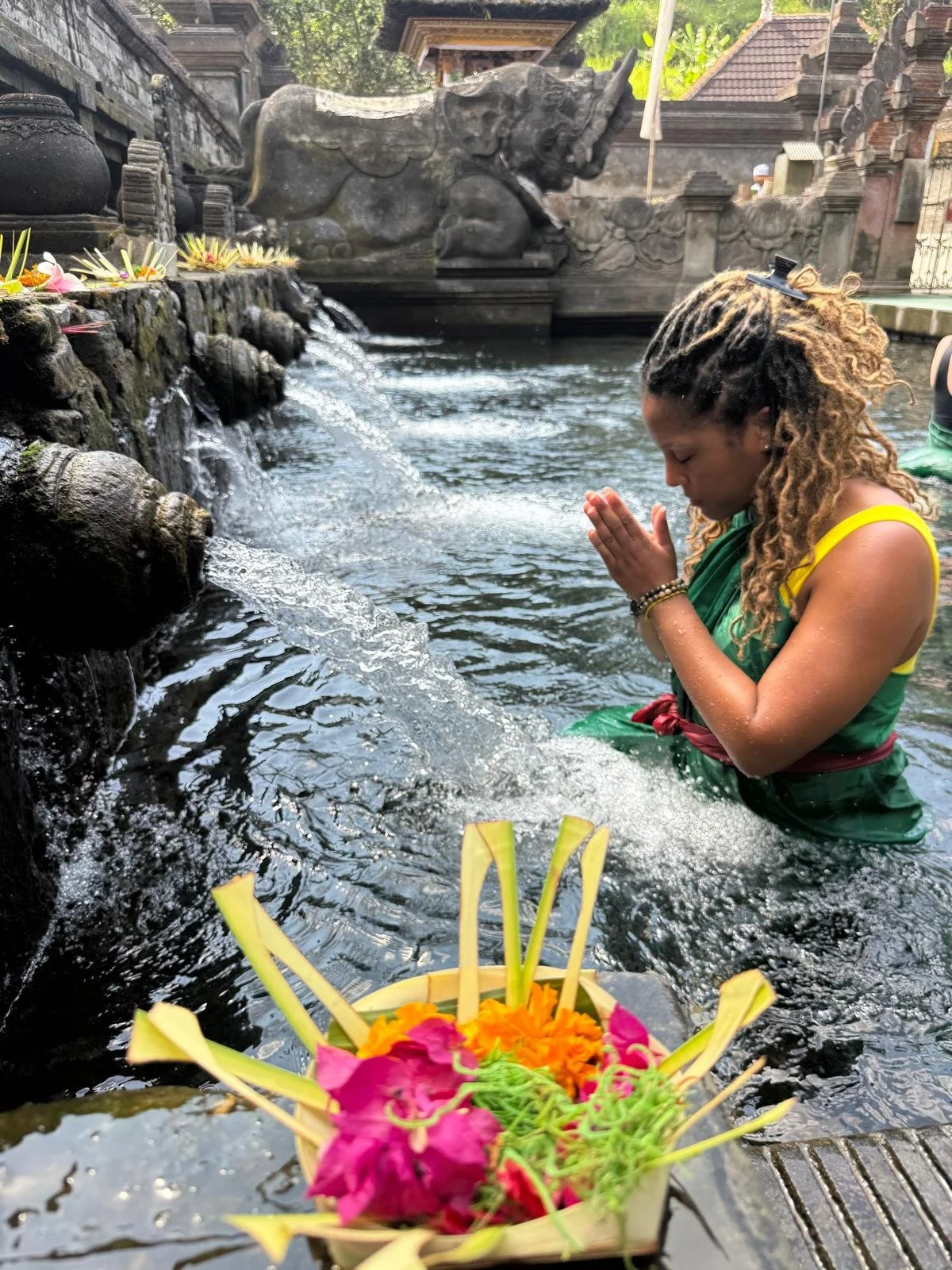
Praying in the water with my chana offering.
One morning, our group participated in a Holy Water Purification Ritual, called Melukat in Bali. I don’t remember the one that I went to but you’re see what I mean in the photos below. We all dressed in traditional Balinese garments before we moved through the water, stepping from one spout to the next as each stream cascaded over us. We prayed with a Hindu priest at the end of the ceremony outside of the water pool area.
Although I don't subject myself to religious practices and never have, I have an appreciation for rituals that touch my soul, and this one resonated deeply. The chill of the water, the rhythmic nature of the experience, and the steady presence of the priest broke through the part of me that was always observing and planning. For the first time during that trip, I was not merely an onlooker in my life; I was immersed in the experience, soaked, barefoot, and entirely present.
Joy followed closely behind that sense of presence, lingering into the next interesting moment which was far less sacred. A group from the resort decided to sample Luwak coffee, humorously known as “poopy coffee”, because it’s exactly what it sounds like. I watched women who had just emerged from holy water scrunch their faces, laugh, sip, and erupt in laughter once more, and it felt good to be present with that too. Honestly, it wasn’t bad. It didn’t have a hint of poopy to it and I was fully present.
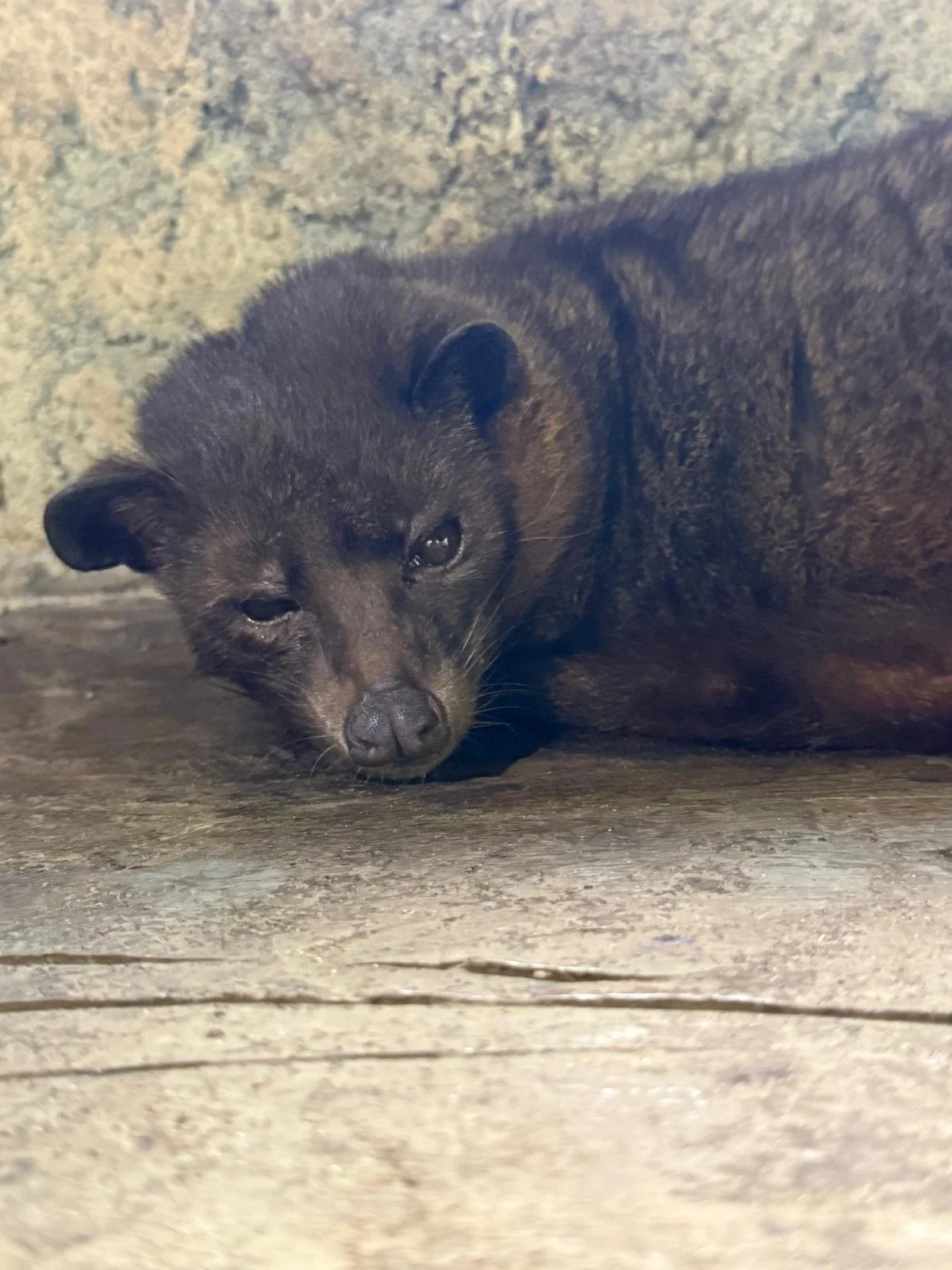
Luwak, the maker of the Luwak Coffee.
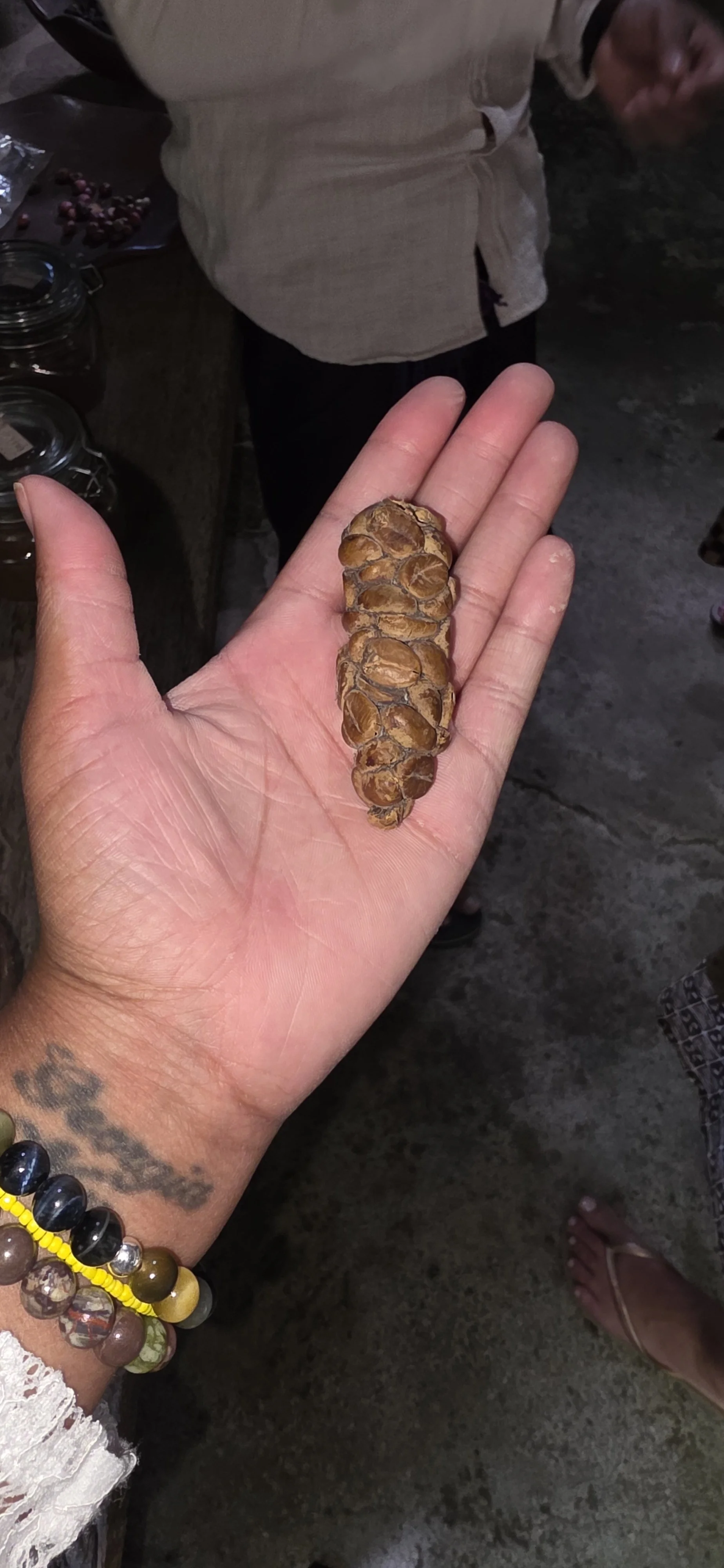
As evidenced by 😁

Coffee sampler. All were very yummy!
This is a lesson about rituals that I keep rediscovering. It doesn't just open the door to the sacred but also invites you to embrace your entire life, including the absurd, human, and poopy coffee moments.
The Obstruction
Yet, one beautiful morning doesn’t erase a pattern, and by the following day, the feeling of disconnection returned. So, I attended an already planned Theta Healing session and posed a straightforward question: what is preventing me from achieving success? Theta Healing is a form of hypnotherapy that directs an experiencer to the theta part of consciousness to speak to the subconscious. It was really intriguing.
The response was both surprising and unsurprising. What emerged was a belief that I held a responsibility to heal others, specifically through mediumship. It wasn’t a calling but rather an obligation, one that I had carried for so long that it began to feel like part of my identity rather than a burden.
Reflecting on that, it became clear why I struggled to experience true rest. You can't completely relax on a massage table when part of you believes it’s your duty to bear the world's grief. You can't engage with a table of laughing women when part of you is worried that you’ll give the wrong message in a mediumship session and cause harm to someone. The anxiety wasn’t arbitrary; it was the nervous system of a woman who had taken on more responsibility than any one person should.
So, I let it go. I didn’t part with the gift or the love I have for this work, only the belief that I owe it to everyone and that my self-worth hinges on how much healing I carry, requiring me to earn my status through carrying it all. Oh the lies we tell ourselves.
What came to me after releasing that burden
Here’s the part that still brings a smile to my face. Shortly after that session, someone contacted me to collaborate on a mediumship group demonstration. I’m excited about it, and I’ll share details as soon as I can, but what moved me the most was the timing. This invitation arrived immediately after I ceased to view mediumship as a debt and started embracing it as the gift it was always meant to be. Mediumship is something I share willingly, not out of fear of the consequences if I don’t.
Returning home, honestly
I wish I could say I returned home feeling transformed, but the reality is that the transition back has been challenging. Jet lag hit me hard, and some anxiety accompanied me, primarily around the next steps in my career and what this new phase requires of me.
The difference is that I now recognize it. When anxiety arises, I can determine whether it stems from my calling or from that old belief that everything is my responsibility, and more often than not, it’s the latter trying to re-enter. Nope, not going to hold that shit anymore. I am no longer obliged to follow it. I can ground myself, recall the sensation of cold water on my face, remember the laughter over poopy coffee, and choose to move forward motivated by desire rather than obligation.
For me, this is the happy ending….not a trip that resolved all my issues but one that highlighted what I had been carrying, allowing me to finally release it and return to my life feeling somewhat lighter.
If your experience resonates with this
Self-care is wonderful, but it can’t address a belief it remains unaware of, which is why many women engage in all the right practices yet still feel disconnected. The Psychospiritual Grief Method was created to address precisely this. It’s where the nervous system, Spirit, and inherited or absorbed beliefs can work together collaborating to enable healing to reach those areas of beliefs to relinquish their power and along transformation to begin.
If you're prepared to confront what may be quietly hindering you, here are four options to embark on this journey with me.
1. 📞Schedule a consultation call. If you’re burdened by grief, anxiety, or a sense of responsibility that feels increasingly heavy, let's discuss potential support options for you.
2. 🎓 Participate in the Psychospiritual Grief Method training. For clinicians, my 6-CEU training, The Psychospiritual Grief Method: Grief, Disenfranchised Loss, and Culturally Centered Care for BIPOC Clients, launches on October 17 and teaches how to integrate spirit, culture, and the body into grief care while maintaining your clinical foundation.
3. 🍂 Join the waitlist for The Elements of Grief Course. My self-paced course, centered around Earth, Water, Air, Fire, and Spirit, will be launching soon, and the waitlist opens this Monday.
4. 🌿Join the Grief Sanctuary to gain access to weekly rituals, meditations, or journal prompts to help you through your grieving season. I plan on hosting a training for rituals in my next training in the membership. Hope to see you there.
Whatever you might be carrying at this moment, I hope you discover the ritual, moment, or individual that helps you acknowledge it, and may you grant yourself the freedom to release what was never meant for you to bear.
With care and intention,
Amber Choisella

Prolonged Grief Disorder Is a Real Diagnosis but It's Missing Half the Picture
What the Clinical Language for Extended Grief Still Doesn't Account For and Why That Gap Is Producing Harm.
In 2022, Prolonged Grief Disorder (PGD) became an official diagnosis in the DSM-5-TR. Many clinicians in the mental health community saw this as a significant step forward. It acknowledges that some individuals experience grief that goes beyond what’s considered normal, which can require professional attention and help. This recognition is crucial; those living with debilitating grief deserve care that respects their experiences, rather than being told to simply wait it out and let grief run its course, essentially.
However, the current definition of PGD is lacking in an essential aspect. This isn't just a minor flaw; it's a significant gap that impacts how mental health professionals understand and treat many individuals who fit the diagnostic criteria. The missing element is the spiritual aspect of grief. Often, grief doesn’t linger because a person is unusually attached, avoidant, or unable to process their emotions. No. Instead, it may persist because the spiritual implications of their loss haven't been addressed. The ongoing presence of the deceased might be seen as pathologically attached rather than as a legitimate part of their grief. The cultural and ancestral factors are often remain unrecognized in clinical settings, and grieving individuals often have experiences that are failed to be accommodated with the current diagnostic framework for grief.
When Stuck Grief Is Actually Unmet Spiritual Need
Clinicians frequently encounter individuals whose grief extends well beyond the typical timeframe of 6 months. These individuals may have engaged in significant therapeutic work and can articulate their feelings with clarity and emotional insight. Yet, they still carry an unresolved weight, often described as "unfinished business," with no clear source. This situation might resemble PGD, and sometimes the diagnosis fits perfectly, that help symptoms of grief alleviate with appropriate clinical interventions; but, in some cases, grief endures because it reflects an unmet spiritual need. These individuals may yearn for an ongoing relationship with the deceased, which the clinical framework mistakenly interprets as unhealthy attachment. They might also need their cultural and ancestral connections to be acknowledged, rather than reduced to individual psychological experiences. The spiritual signs and experiences that arise after a loss i.e.: dreams and feelings of presence are often dismissed instead of being recognized as valid.
When treatment focuses solely on the psychological aspects of grief without addressing the spiritual dimension, progress can stagnate. This plateau might be misread as resistance to treatment, or as complexity that requires a different approach. In reality, it signals that the full scope of what grief is responding to hasn't been fully understood.
The Risk of Over-Medicalizing What Isn't Pathology
The medicalization of grief is a tricky topic. At different times the field has underplayed severe grief responses that truly needed attention while also over-diagnosing normal grief reactions. The introduction of PGD continues this complicated trend. The criteria for PGD state that grief must cause significant distress or impairment for at least twelve months following the loss to permit a diagnosis. This framework isn’t inherently flawed; it captures genuine cases where grief has become disabling. However, a nuanced understanding requires cultural and spiritual literacy that many training programs for clinicians lack.
Take, for example, a BIPOC/BBIA woman mourning her mother has maintained a vibrant relationship with her mother's Spirit through ancestral practices. Her deep and prolonged grief, viewed through a dominant cultural lens, may resemble PGD. Applying that label without understanding her cultural context would be misguided and cause harm. It imposes a dominant framework on grief that may not fit her lived experience.
Where the DSM Framework and Lived Spiritual Experience Separate
The DSM has been shaped by a clinical culture that often overlooks the spiritual dimension of human experience. As a result, the diagnostic system can effectively capture the psychological and behavioral signs of grief but tends to ignore what grief is addressing on a spiritual level.
For many BIPOC/BBIA women, grief doesn’t separate into neat psychological and spiritual categories. The DSM sees ongoing longing for the deceased as indicative of disordered grief. In contrast, many cultural traditions view that longing as a natural expression of love, demonstrating that death doesn’t sever all ties. The DSM may interpret difficulty in accepting a loss as a symptom of prolonged grief, while spiritual frameworks recognize the reluctance to accept finality as spiritually valid rather than psychologically avoidant.
These differences aren't insignificant; they reflect fundamentally divergent interpretations of grief's purpose and produce different treatment approaches. Not addressing the spiritual dimension can lead to stagnation and create obstacles for clients whose grief is tied to something beyond psychological factors.
The solution isn’t to abandon clinical care for spiritual practices. Instead, it's about finding a balance, integrating both perspectives. A framework that respects the need for clinical precision alongside spiritual understanding is essential. Clinicians trained in this approach can acknowledge PGD as a valid diagnosis while also discerning when a client's grief stems from unmet spiritual needs. This vital understanding shifts how the therapeutic process unfolds.
Learn This Framework Before October Is Gone
For clinicians eager to develop this integrated model, the Psychospiritual Grief Method offers training. It encourages a deep understanding of both clinical and spiritual tools needed for working with clients experiencing complex grief.
🎓 The Psychospiritual Grief Method Training October 17th, 2026, for clinicians who are ready to develop both/and model in their own practice, with the clinical and spiritual rigor that the clients carrying the most complex grief require. Six CEUs, small cohort by design, seats are filling.
Register for the training here
🍂 The Elements of Grief Course: opens October 25th, a self-paced psychospiritual course built for clients navigating grief that standard frameworks haven't been able to reach, and a resource clinicians can refer clients to with confidence that the framework holding the course is both clinically grounded and spiritually literate.
Waitlist coming soon
✨ The Inner Circle is for women ready for deeper, more personalized ongoing support as the understanding of what grief is and what it requires continues to deepen.
📞 Grief Consultation Call is for California residents navigating grief that hasn’t moved despite consistent effort, where a conversation about what grief is actually responding to is the place to begin.
Schedule consultation call here
With care and intention,
Amber

Your Loved One Isn’t “Gone”. They’ve Just Changed Form.
A Spiritual Reframe That Isn’t About Denial On the Continuity of Life After Death. Not Your Typical Discussion with A Grief Therapist.
When someone says “they’re still here” to a grieving person, there is often either a flat response or there’s jerk backward of the neck because what do you mean they’re still here but I can’t see, feel, nor talk to them? It’s often not received well, understandably.
I’ve been on the receiving end of that jerk response in my work, and I’ve watched it happen to other folks offering spiritual comfort. The statement “they’re still here“ has been used often enough as a way of short-circuiting grief, in an effort to help moving someone past the acute pain of loss before that pain has been adequately felt, but guess what? It’s a false comfort. Even as a medium I say this because without evidence of life continuing after the change called death, it feels fantastical.
What I’m offering in this post isn’t a softer version of the same claim designed to produce less jerking, rather and it is a more precise version, because I think the flinch is often responding not to the underlying truth of continued existence but to the inadequacy of how that truth gets communicated, and precision is what changes that.
The Difference Between Spiritual Bypassing and Spiritual Accuracy
Spiritual bypassing is when a spiritual framework is used to avoid the full experience of something difficult rather than to hold it and transverse through the experience, and “they’re still here” functions as bypassing when it’s offered as a reason to stop grieving. It’s an action to move someone away from their pain rather than to help them understand the fullness of what they’re moving through.
Spiritual accuracy is something different. Spiritual accuracy is the attempt to describe what is actually true about the nature of consciousness and death and what continues after the change called death. To say “they changed form“ is closer to accurate than “they’re gone“ because it’s the truth. This truth corresponds with evidence that originates from both mediumship work and from the testimony of grieving people across cultures and traditions over thousands of years.
The distinction matters because a grieving person deserves both the full depth of their grief and the full truth of their relationship to grief. Those two things aren’t in competition with one another. You can fully grieve and hold space for the fact that what you’re grieving is a change in form rather than an annihilation.
What Mediumship Work Has Taught Me About Form and Essence
Years of evidential mediumship practice and demonstration has taught me several things about what continues after death, and the one I fact that never ceases to surprise me is that the personality doesn’t disappear.
Evidence of mediumship includes descriptions of Spirit’s physical form in life, their personality, fashion style, their unique smile, sometimes their passion for vehicles, and memories that they want to share to solidify the connection. This provides proof that the change called death on only that, a change.
The physicality of our loved ones is forever lost to time, time that we never receive back. We have to learn how to live a new reality without their physical presence and that’s a change we need to navigate through. This fact can’t be superseded by mediumship because that would be spiritually bypassing. Mediumship is meant to assist in the healing process, not to eradicate grief because remember, our bodies experience grief too. If you find yourself struggling with grief, I recommend that you seek professional help in navigating this new reality of this permanent physical loss. If you’re in California, I offer a free grief counseling consultation. You can schedule your consultation here.
What One Client’s Experience Showed Me
A woman came to me approximately fourteen months after her mother’s death and expressed a great deal of confusion because she was experiencing vivid dreams of her mother saying things that the woman couldn’t have generated from her own grief. She shared that her mother was giving her specific and referencing details that she was unaware of at the time but later confirmed were accurate. She had no idea that what she was experiencing was true communication from her mother who was no longer existing in this reality. She struggled with this for a while because she was not sure if she wanted the door of communication open. We worked together and she eventually graduated with the clarity she needed and was able to establish a connection with her mother that aided to her grief journey that she was comfortable with.
The work we completed together confirmed the connection in ways that were evidential rather than general, and what shifted for the woman wasn’t that she stopped grieving but that her grief changed in quality. She had been grieving as if her mother had permanently become nothing and after the session she was grieving as if her mother had relocated. Her grief still hurt and impacted her, but it ultimately changed her relationship with grief.
How to Open to This Without Forcing Belief
I’m not asking you to adopt a belief before you have the experience and I’m not forcing a belief in the continuation of a loved one’s existence without direct experience. I’m just providing another means of healing that has been proven to support grief. That’s why I practice evidential mediumship because the evidence that comes through helps loved ones understand that death is only of the body not the soul.
Now, it’s important to always remain open and curious about what does arrive. Paying attention to your dreams especially when they are vivid and you are receiving information. Notate that because you’ll be able to look back on it and connect dots and gain understanding. This is a component of The Psychospiritual Grief Method Framework that I created, work from, and teach other Clinicians who work with grief. This is help you learn how to trust yourself and Spirit in the long run.
If You Want to Explore This Further
📞 Spiritual Consultation with Amber are for women who want to explore their own connection with a loved one who has passed, to understand what is arriving in their dreams or their waking moments, and to receive individual support in navigating what continues rather than only what was lost. Available worldwide.
🌿 The Grief Sanctuary is for ongoing resource and monthly spiritual grief support for women who want to hold both the full depth of their grief and the possibility of continued connection, in a space that does not ask them to choose between the two.
With care and intention,
Amber

You Keep Receiving the Same Message and Refusing to Listen (Until You Have To)
They call that being hardheaded, or maybe it’s avoidant, maybe even ignorant. If you’re reading this you’re ready to receive that message.
You’ve had that feeling for a while now that something is getting ready to happen. You could be seeing synchronistic numbers, seeing patterns that only make sense to you, but instead you ignore it and still try to “manifest a change” not recognizing that change is occurring right in front of you.
Resistance. Why the resistance? What are you not wanting to face? What are you afraid of?
The art of surrendering is one of the greatest lessons we evolve to learn. I know I struggle with surrendering; it’s a constant lesson for me. Resistance is just another phrase for control. You see the message, you feel the message, might even hear it but will ignore it until Spirit stops you directly in your tracks and you have no other option but to receive it. Stop self-sabotaging.
What An Intimate Evening with Spirit Taught Me About Surrendering Control
The Intimate Evening with Spirit event that I held in Auburn, California in the middle of August did something to me that I wasn’t prepared for. The experience showed me when I step fully out of my own way and allow Spirit to lead without my management, it’s a beautiful experience.
I arrived carrying a specific set of expectations about what the evening should be, how it should feel, and what would constitute success, but what actually happened was that I met with one attendee who made me realize that it’s not about how many people attended the event, it’s who Spirit has the opportunity to connect with. I went from taking long pauses and deep breathing to ensure the connection to surrendering and allowing Spirit to work through me.
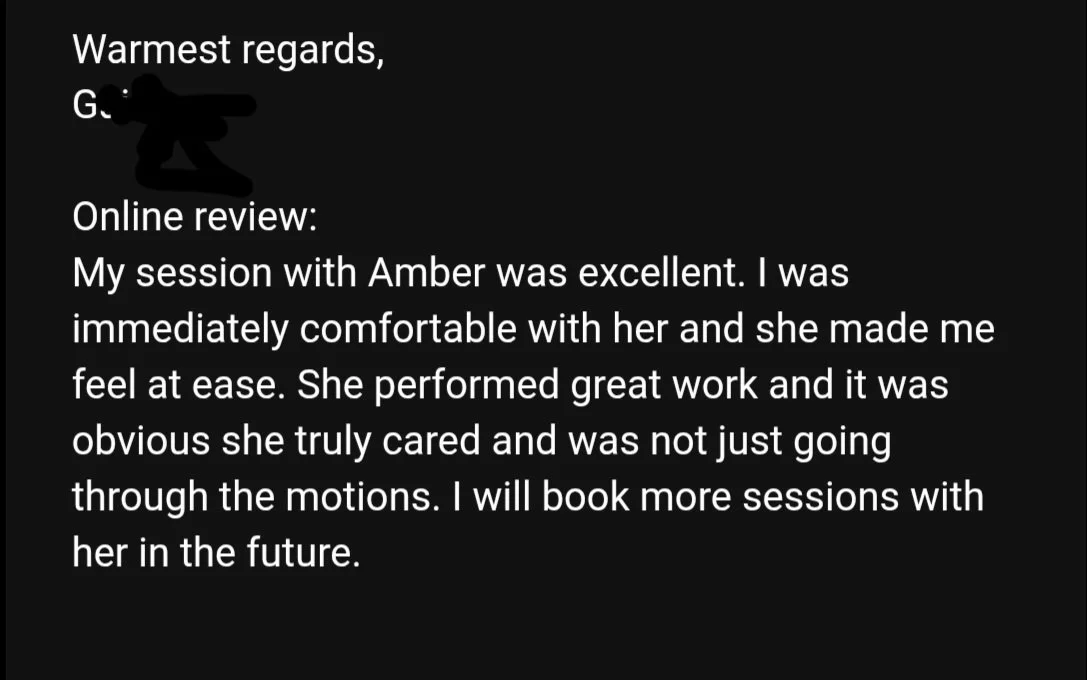
Mediumship Review from previous client.
The act of surrender was felt within my body and felt by the client as well. I trust Spirit to know what the room needs rather than deciding in advance what I am going to give it.
Stop being hardheaded and surrender to that message that Spirit has been trying to have you accept.
The Course That Almost Didn’t Happen
I’ve been working on something for a while.
The Elements of Grief have been living inside me in various forms for years and the decision to build it into a structured course surfaced a fear expected. What if the course isn’t adequate for the woman who is holding more grief than just grief due to the change called death?
I sat with that fear longer than needed. This fear came from my relationship with visibility, and specifically the vulnerability of offering something that emerged from my own grief, spiritual journey, and my own integration rather than from an AI creation that I could stand behind without any personal exposure.
Spirit was clear about this in a way that was almost irritating but a course about psychospiritual grief built by someone who has merged spirituality into the clinical space is necessary, now.
So, I stopped avoiding and I kept building. The course opens October 25th, and I am at peace with what I’m creating.
The Difference Between Forcing Alignment and Allowing It
There’s a way of doing spiritual work that looks like alignment from the outside but is actually control dressed in the language of alignment. Oohh I ‘ve been practicing that form of “alignment” for long too long enough but now I’ve become almost an expert at distinguishing between the two.
Forcing alignment has a quality of exhaustion to it. It’s exhausting doing something that’s not inherently difficult because the effort is going into maintaining the forced connection rather than into the work itself. The energy that should be available for the actual service is being consumed by the effort of holding a position that doesn’t need holding.
Allowing alignment feels entirely different in the body, and the clearest signal I ‘ve found is that when I’m in genuine alignment with what Spirit is asking of me, the work doesn’t feel like I am producing it, rather it feels like I’m receiving it and passing it along. Exhaustion, comes hand in hand with control.
August was a month of learning to recognize the difference more quickly and with less resistance, and I’m taking that recognition into September as one of the most useful things I have accumulated in a while and I’m passing the knowledge onto you.
What I’m Asking Spirit for Heading Into September
This month of September 2026, I reclaim that clarity has no room for control. I surrender to Spirit without the need to control what clarity means and trust it will reveal itself to me as it always does.
The willingness to move at the pace the work actually requires rather than the pace my planning assumes is necessary. Time after time I’m reminded that I don’t control shit and it’s best to work with Spirit instead of against. I’m hardheaded.
September feels like a turning, and I’m ready for it. I’m asking to be surprised by what it holds rather than managing it into a shape I can recognize before it arrives. What are you being asked to be surprised about?
If You Are Sitting With Your Own Resistance Right Now
The thing about the kind of resistance I have been describing is that it almost never announces itself as resistance, and it arrives instead as prudence or practicality or appropriate caution, and the difference between those things and genuine discernment is one of the more interesting questions I know how to sit with.
If something in August stirred a familiar quality of sophisticated avoidance in you, if there is a message you have been receiving and finding reasons not to fully hear, a consultation is a space to bring that without needing to have it figured out before you arrive.
📞 Spiritual Consultation with Amber is for women sitting with their own resistance, their own repeated message, and a sense that Spirit is trying to get their attention through whatever channel they have left available.
🌿 The Grief Sanctuary is for women who want ongoing community and monthly practice as they move through the integration work that August and September and every season of genuine healing requires.
✨ The Inner Circle are for women who are ready for deeper, more personalized ongoing support as the ancestral and grief work deepens beyond what the monthly container alone can hold.
With care and intention,
Amber

What Psychospiritual Counseling Actually Is (Why I Had to Create It Myself)
How My Own Grief, Cultural Displacement, and Spiritual Awakening Became a Framework And Why BIPOC/BBIA Women Needed It to Exist
It’s not a term I made up, but it is a term that I have created a part of my clinical identity. Psychospiritual counseling holds the psychological and the spiritual in one clinical container simultaneously, treating them as inseparable dimensions of the same human experience rather than as separate domains requiring separate practitioners at separate times in separate spaces. Heavy on the separate spaces.
That definition sounds simple, but simplicity is deceptive, because the actual practice of doing this work with integrity requires a kind of double fluency that clinical training and spiritual development alone doesn’t produce. Most practitioners end up choosing one language over the other because holding both fluently is genuinely demanding, and the clinical field historically has never held such space before.
I didn’t arrive at this work by theoretical interest. I arrived at it the way most BIPOC/BBIA women arrive at anything that actually fits them, which is naturally exhausting every available option that was supposed to fit and finally being forced to build something that did (insert deep sigh here).
What the Field Was Missing When I Showed Up to It
Clinical psychology, as it was handed to me in my training, operated on assumptions about what grief is, where it lives, and how it moves. The problem with this is that it hasn’t been tested against the experience of Black/Brown/ Indigenous/Asian women or ancestral grief/ the kind of loss that doesn’t have a clean narrative origin, and the limitations of those assumptions don’t always announce themselves in theory, but they show up consistently in sessions. I noticed a gap in treatment.
The spiritual dimension of grief was the gap I kept encountering, or the lack of spirituality in treatment. I’ve had women who had experienced the presence of their deceased loved one, not as a complication of their bereavement but as a continuing relationship that was helping them grieve. Although current grief frameworks ask Clinicians to place spiritual experiences/encounters aside so that the psychological aspect of grief could be worked with as if spiritual experiences were bypassing grief completely.
This wasn’t clinically adequate, and I knew it. I also knew that naming that inadequacy openly inside professional clinical culture required a kind of foundation that I had to build. Liberation Psychology is similar to what I created, which you can read more here on this about this specific framework. I created a framework that was missing in the grief clinical space, a space I’ve found myself in throughout many chapters in my life. Which I’ll speak more to in a bit.
The Disenfranchised Grief of Cultural and Spiritual Practices
There’s a specific kind of grief that doesn’t have formal recognition in most clinical contexts and the field names it disenfranchised grief, meaning grief that the culture or the institution around the grieving person doesn’t recognize as legitimate, regardless how significant the loss was which then goes largely unsupported because the systems designed to support grief were designed with a different kind of loss in mind.
For BIPOC/BBIA women, disenfranchisement runs through both the cultural and spiritual dimensions of their experience in ways that impact each other, because the spiritual practices that their lineages carried were frequently dismissed, criminalized, or simply treated as non-existent by the same Western institutions that then offered clinical support for grief without any framework or understanding for their cultural and spiritual practices.
A Black woman entering in therapy who had a grandmother who communicated with ancestors and or practiced Hoodoo or even Voodoo and she grew up watching that communication and/or ritual practice as a real and living relationship with the dead, do you think she would feel guilty in bringing this aspect of her life experience into the clinical space? Especially for grief work… probably not based upon current frameworks outside of a psychospiritual framework. Or what about the Latina/Latinx woman who practices Santeria or the Indigenous woman who is a shaman or medicine woman who hides that significant aspect of themselves in the clinical space?
These are reasons I wanted the Psychospiritual Grief Method to address directly, because the disenfranchisement of ancestral spiritual practices isn’t a minor cultural sensitivity issue but a structural absence in the field that has been producing real harm to the populations who are in most need of adequate grief support.
My Own Journey Was the Research
This is where the Psychospiritual Grief Method originates...
I am a Soulann woman from a Louisiana lineage. My grandmother practiced Hoodoo without calling it that, passing down a particular quality of knowing. She was my first supporter in connecting to Spirit before I understood what being psychic or a medium meant. She ventured through different religions and took what resonated with her and gave me permission to search for truth within myself. She read the bible daily and never said my experiences were demonic. She was my safe space to communicate my experiences with before I found it in the clinical field. I spend years managing and compartmentalizing who I am while I building my clinical identity because it felt safer and more legible to the institutions I was moving through.
The grief of that compartmentalization was its own form of disenfranchised grief. I was unconsciously grieving a form of myself that I felt like I couldn’t fully be present with because I didn’t feel safe to bring it into the many sessions of multiple grief episodes throughout my life.
My spiritual awakening occurred the night before I experienced a car accident with my grandfather. We were on route to the hospital where my grandfather transitioned shortly after. The prophetic feeling left me with a deep curiosity to learn more about my abilities which included the developing mediumship and training with The Morris Pratt Institute, The University of Metaphysics where I’m on the PhD track, and the Arthur Findlay College. Yet, the shift in perspective occurred earlier this year when I decided that I was no longer willing to compartmentalize myself because I knew that they are women who were just like me who need to feel safe in the clinical space. Spiritual individuals are human and need mental health treatment too. They need a place to be safe enough to bring their entire selves into the therapeutic environment for holistic healing. Theres’s an increasingly undeniable reality that the clinical and the spiritual aren’t separate domains of my identity but one continuous knowing.
The Psychospiritual Grief Method didn’t emerge from a literature review, although literature definitely supports it. The framework emerged from lived integration, sitting with my own grief, my gifts, my own ancestral inheritance, and refusing to allow any of them be more legitimate than the others. This is what needs to be taught.
What Psychospiritual Counseling Actually Offers BIPOC/BBIA Women
When a BIPOC/BBIA woman enters a psychospiritual counseling relationship, she is entering a space that was built with her experience as the central design consideration rather than as a demographic variable to be accommodated and that difference is palpable from the first session, because the questions the practitioner knows to ask are the questions that locate her grief at its actual level rather than at the level the standard framework can reach.
Grief that is ancestral gets addressed as ancestral grief, with frameworks and practices suited to inherited loss rather than only personal loss. The spiritual experiences that are part of how she is processing the death of someone she loved gets addressed as real dimensions of the grieving process, with a practitioner who has the fluency to meet them rather than the training to redirect them. The cultural practices and beliefs that shape her relationship to death and to what continues after death get treated as clinically significant context rather than as interesting background information that falls outside the scope of the session.
This is what psychospiritual counseling makes possible, and it is also what the training on October 17th is designed to produce in the practitioners who attend it, because the women who need this kind of care need more practitioners who can offer it, and the training is how that supply increases.
For the Clinician Who Recognizes This Gap
If you have been improvising through the gap I described earlier, reaching toward something more adequate than what your training gave you without yet having the language or the framework to name what you were reaching toward, the Psychospiritual Grief Method Training on October 17th is where that improvisation becomes a methodology.
🎓 Psychospiritual Grief Method Training: October 17th, 2026, six CEUs, small cohort by design, built for clinicians who are ready to hold the full complexity of BIPOC women's grief with the clinical and spiritual rigor it actually requires.
🌿 The Grief Sanctuary is for women who want ongoing community and monthly psychospiritual practices that hold the cultural, spiritual, and ancestral dimensions of grief the clinical field has historically ignored.
✨ The Inner Circle is for women who are ready for deeper, more personalized ongoing support and direct access to Amber as the work continues to deepen.
With care and intention,
Amber Choisella

Your Ancestors Grieve Too: A Spiritual Look at Inherited Loss with A Look at Epigenetics and Ancestral Work
A beginning statement that you feel in your bones is true.
The Grief You're Carrying Might Not Have Started With You.
There’s a grief that arrives without an occasion.
It’s not triggered by a loss you can point to or even be connected to anything that happened in your own lifetime. Yet you feel its presence in your body with specificity and a weight that doesn’t feel imagined. Something that feels real that’s been here longer than you have, something you inherited rather than acquired.
This is what’s known as ancestral grief and it’s one of the most difficult grief presentations to name because it resists the framework that most grief support is built around. The framework of personal loss tends to relate to where something in your own life ending and the grief belongs to that ending whereas ancestral grief doesn’t fit that framework because that loss isn’t something that directly happen to you, and naming it requires a willingness to locate yourself inside of a larger story than the one that begins with your own birth.
I want to offer you a spiritual framework for understanding what ancestral grief is and how to begin recognizing it because the recognition is the beginning of the tending that begins to move what’s been stored in your lineage for longer than any living member of your family can remember.
What Ancestral Grief Looks Like in the Body
Ancestral grief doesn’t announce itself with the clear signal of personal loss because it’s disguised as something that looks like a personal pattern, a personality characteristic, or a chronic physical state. Its disguise is so convincing that most folks who are carrying it have never considered the possibility that what they’re living with is grief rather than simply who they are.
It shows up as a sadness with no clear source. A low-level mourning that’s simply always present. It intensifies at specific times of year, around certain family gatherings, or in the presence of certain people without any obvious reason for the intensification. It doesn’t respond to interventions that personal grief eventually responds to because those interventions are aimed at a loss that can be named and this grief is aimed at losses that were never named.
It shows up as a body that holds tension in specific locations such as a chronic tightness in major parts of the body: chest, throat, stomach, and hips. It’s not attributed to current stress and it doesn’t fully release even in periods of genuine rest, because the body is holding something older than the current life situation. It’s something that’s encoded in the nervous system at a level that precedes conscious memory.
Clinically this is known as epigenetics. Read more about this from this article by Dr. Robert M. Post, MD, The Epigenetic Connection to Black Disparity.
It shows up as a sensitivity to specific kinds of loss (police brutality, encountering police, Black bodies found lynched in a tree, laws that push for racial discrimination), because the immediate loss is activating a grief that is much older and much larger and that has been waiting for exactly this kind of trigger to finally have a channel through which to move.
It shows up as an exhaustion that sleep can’t fix. What would it be like to move through the world without it?
Signs That the Loss You're Grieving Is Inherited Rather Than Personal
The clearest sign that what you’re carrying is inherited grief rather than only personal grief is that this grief feels older than you are, like an inherent trait. Asked to carry without being asked whether it’s wanted to be carried.
Another sign that grief is inherited is that there’s a pattern in the lineage rather than just a pattern with you. You can see and recognize the same emotional quality or the same kind of loss appearing across multiple generations in ways that suggest it’s being transmitted rather than independently generated.
Lastly, if the grief responds to ancestral practices than to personal processing, you know, such as creating the intention to sit with your (healed) ancestors or through engaging in an ancestral ritual that acknowledges what came before you, know that you are dong the healing work to heal your ancestral lineage…. And it works.
A Spiritual Way to Begin Tending Inherited Grief
The spiritual approach to inherited grief isn’t the same as the clinical approach. It’s not better or worse but it’s a specific approach of what inherited grief requires, because clinical work addresses the psychological and somatic impact of the inherited grief on the individual. The spiritual work addresses the relationship between the individual and the lineage that produced the grief and both dimensions need attention, though not necessarily simultaneously and not necessarily by the same practitioner.
Here’s a ritual practice for you to try if you feel aligned to work with it:
Begin by finding a quiet space, light a candle, and then speak aloud to your lineage, not to a specific ancestor if you don’t know their names, but to the collective, the whole of what came before you, and say something like: "I know I am carrying something that did not start with me, and I am acknowledging that now, and I am asking my healed ancestors to help me understand what I am holding and where it came from and what it needs from me to begin to move."
Then sit in silence with a journal open and write whatever arrives, without evaluating whether it is accurate or significant. The act of writing is the act of giving ancestral grief a form it hasn’t had before.
Do this practice regularly rather than once because inherited grief wasn’t accumulated in a single session and it won’t release in one either. Remember the relationship you’re building with your lineage through this practice is more important than any single piece of information that arrives in any individual sitting.
You Don't Have to Tend This Alone
📞 Spiritual Consultation Call with Amber is a free consultation to determine your spiritual needs. Whether that be a spiritual reading (Mediumship/Intuitive Tarot Reading), Spiritual Counseling, or Spiritual Development. This 15-20 minute call helps to identify needs and if there’s an alignment to work together.
Schedule your consultation here
🌿 The Grief Sanctuary is a space that provides ritual and meditation practices and a bit of psychospiritual information to help you understand yourself and your grief on a weekly basis. This space was designed to hold ancestral and inherited grief alongside personal grief, with women who understand the territory because they are navigating it too.
✨ The Inner Circle is for women who are ready for deeper, more personalized ongoing support as the ancestral grief work deepens and asks more than the monthly container alone can hold.
With care and intention,
Amber

How I Use Tarot as a Clinical Tool (Not a Fortune-Telling One)
What Happens When You Put a 78-Card Reflective Framework in the Hands of a Grief Clinician
Tarot has nothing to do with predicting the future and everything to do with accessing what’s already present not yet named. When tarot is held inside a clinical framework by a practitioner who understands grief, trauma, identity, and ancestral psychology, it becomes one of the most precise and ethically defensible reflective tools I’ve ever worked with.
Tarot first presented itself to me through a gift in 2020, because I told myself I wouldn’t work with tarot unless it was gifted to me and once it was, I taught myself to read intuitively.
What I discovered in that process was not a fortune-telling system but a reflective one, and that distinction matters tremendously for how I use it clinically. The clinical reflection of tarot works with the authority of the client, with the card functioning as an externalized mirror of what the client already knows but hasn’t been able to access through direct cognitive processing, and anyways, I don’t use tarot to fortune tell in my spiritual practice, because, well, I don’t have the ability of prophecy… I have the gift of guidance and process.
Why the Cognitive Processing of Grief Gets Stuck
To understand why tarot functions as a useful clinical tool specifically in grief work, it helps to understand why standard talk-based processing has limits with grief that it doesn’t have with every other clinical presentation.
Grief isn’t a primary cognitive experience, even though it produces cognitive effects like intrusive thoughts, difficulty concentrating, and disordered meaning-making. Grief is primarily a somatic and relational experience which lives in the body and in the disrupted attachment system. It’s important to know that grief resides within the parts of the psyche that most individuals need to process a significant loss and to acknowledge that it’s not always the parts that respond readily to direct verbal process. Direct verbal process requires the client to access and articulate what they’re experiencing from within the experience, which is precisely what profound grief makes difficult.
The question "how are you feeling about the loss?" asked to a person in acute or complicated grief often produces either a rehearsed answer that has been refined through repeated retelling and no longer carries much live emotional charge, or a shutdown in which the person cannot access the answer at all and reports numbness or confusion. This doesn’t mean that our client is resistant but because the direct pathway to that space is temporarily closed off by the grief that needs to be processed.
Tarot, used clinically, opens an indirect pathway, and indirect pathways are often precisely what grief requires.
What I Actually Do in a Clinical Tarot Session
When I use tarot as a clinical tool, my client doesn’t come to receive a reading in the conventional sense, which I make completely clear during the consultation call. Tarot is utilized as a projective surface, in the same way that a narrative therapy technique might invite a client to externalize what’s internal so that both the client and the Clinician can look at it from a slightly different angle.
I ask my client to hold a specific question, not "what will happen" but
"what is true right now that I have not yet been able to see clearly," or "what is my grief asking me to pay attention to," or "what is the part of this loss I have been most avoiding,"
and I ask them to identify how they want to work with the deck. Whether that be shuffle and then wait to see which card comes out (my method) or shuffle and spread the cards out to choose the card that feels warmest, or shuffle and then choose the card on top. This process is exploratory on its own. This is the act of slowing down enough to allow something from the interior to surface.
When the card is chosen placed on the table before them, I don’t interpret it for them, because interpretation belongs to the client rather than to me. I ask them what they notice, what the image brings up, what feeling arrives before any thought about what the card is supposed to mean, and I follow that feeling rather than any traditional meaning associated with the card, because the traditional meaning is a starting point at best and a distraction at worst when the goal is accessing the client's own knowing rather than confirming a predetermined interpretation.
What consistently emerges through this process is material that direct questioning wasn’t able to surface such as images, associations, and somatic responses that carry more live emotional charge than the narrative the client had prepared, because the card gave the unconscious emotions a vehicle that a direct question didn’t.
What This Looks Like for Ancestral and Identity Grief
Tarot is particularly suitable for ancestral and identity grief work, because both of those grief presentations involve something that resists a linear narrative, and the tool of tarot offer a non-linear, symbolic, imagistic language that is often more adequate to the experience than not.
A client grieving the loss of a religious identity built around her entire sense of self can’t always describe what she has lost in narrative terms, because the loss isn’t consecutive and it doesn’t have a clear origin point. That is when I would invite her to pull a card for "what the tradition gave me that I carry forward" and a card for "what I am becoming outside of it," the images give her something to respond to that does not require her to already have the story organized.
A client navigating ancestral grief for people she never met can’t describe in narrative terms the grief that lives in her body for losses that predate her own memory, but she can respond to an image on a card with a felt sense of recognition that opens space for direct questioning couldn’t access previously. This is clinical work.
What This Is Not
This work isn’t fortune-telling. The distinction isn’t only professional but ethical and a client in grief who comes seeking clinical treatment and receives a prediction about their future isn’t being served. In fact, she’s being harmed, because prediction in grief has a particular capacity to organize the grieving person's experience around an external authority rather than building the internal authority that healing actually requires.
This work also isn’t spiritual bypassing because the clinical use of tarot isn’t a way of skipping over the psychological dimensions of grief in favor of something that feels more elevated or more spiritual, because tarot is always in service of psychological and somatic work rather than a replacement for it.
Lastly, this specific work with tarot isn’t something any practitioner should pick up and use clinically without both genuine development of their relationship with the deck and a solid clinical foundation in grief, because the combination of those two things is what allows the tool to be used with precision and ethical accountability rather than imprecision and the appearance of depth. I received and continue to receive clinical guidance with tarot through Dreya Blume who is also a licensed clinician.
For the Clinician Who Has Been Curious
If you have been curious about integrating tarot into your clinical practice and have held back because you were not sure how to do it with professional integrity, the Psychospiritual Grief Method Training on October 17th, 2026 addresses spiritual interventions that align with culture. If interested reading more please read more below.
Take the Next Step
🎓 Psychospiritual Grief Method Training, October 17th, 2026 is for clinicians ready to integrate tools like tarot into their practice with full clinical and ethical grounding, alongside the complete ARISE Arc framework for psychospiritual grief work, with six CE credit through the NBCC.
Register at healingwithamber.co/the-psychospiritual-grief-method-training
🌿 The Grief Sanctuary is for women who want to use tarot as a reflective tool for their own grief work within an ongoing community container that holds the full psychospiritual framework.
✨ The Inner Circle is for women who are ready for deeper, more personalized ongoing support and expanded access to Amber as the work deepens.
📞 Free Grief Counseling Consultation are for California residents ready to explore grief support that integrates clinical and reflective tools like tarot into a single coherent framework.
Schedule free consultation here.
With care and intention,
Amber
An Intimate Evening with Spirit didn’t sell out, but this happened instead
August 15th was the date I chose for An Intimate Evening with Spirit group mediumship experience, but things didn’t follow through like I planned, and how things worked out better than I expected.
This time around was different. I actually promoted the event. Created content about the event and allowed myself to become excited for the possibility of showing up in a full group again to be a conduit for Spirit, but a full group was NOT what happened. To understand this expectation, you must know that the first time I held this event it was for a full group.
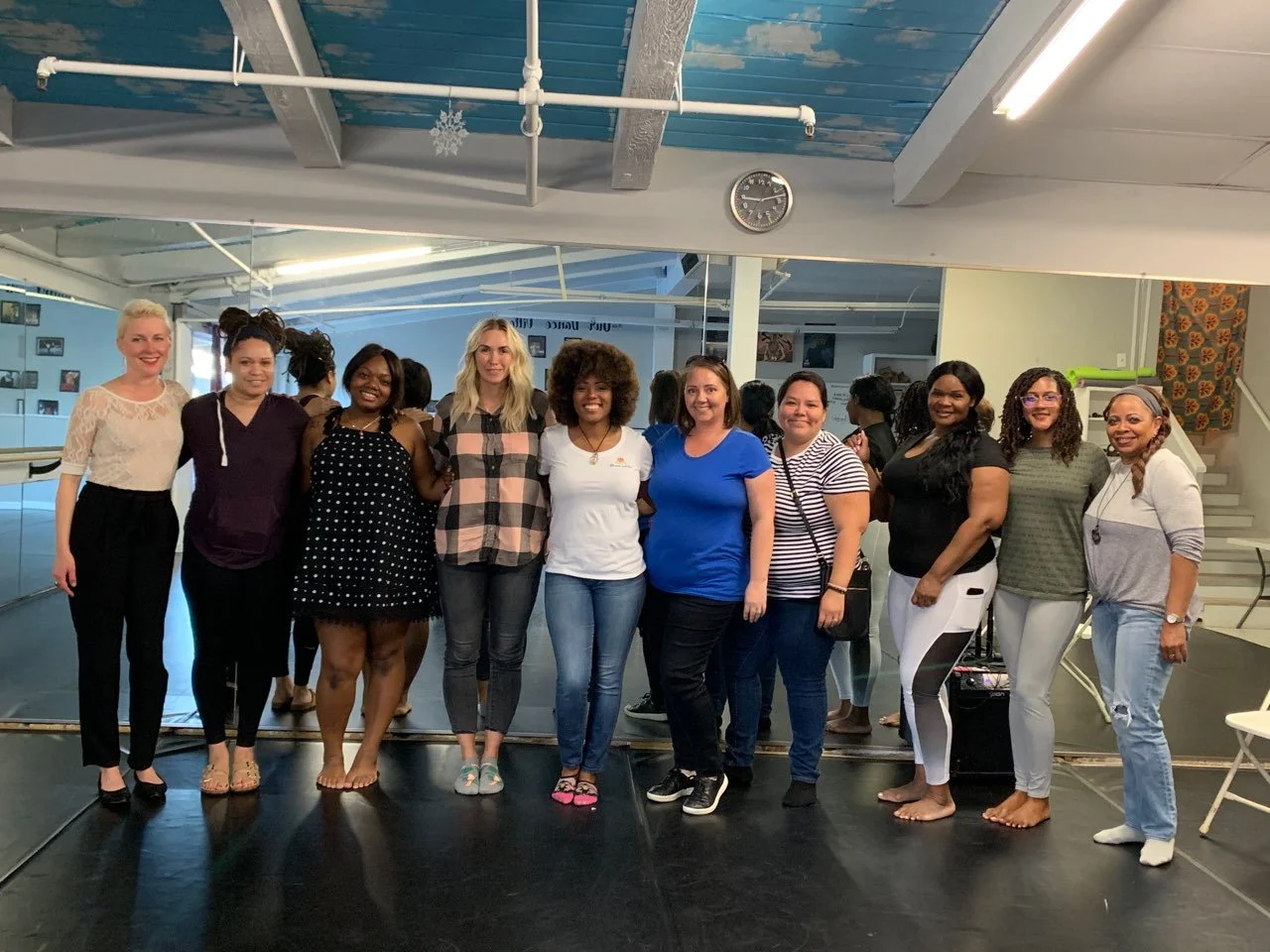
First An Intimate Evening with Spirit Event 1.30.19
I was extremely anxious, but I showed up and allowed Spirit to show out. The event was a success. I held multiple events that year and they were all fully booked and was AMAZING despite the anxiety leading up to the event. My last event was right before the emergence of COVID-19 in January 2020. It was another great event and even more important because it was the first time my twin sister saw me demonstrate mediumship. It was always something I talked about until she saw me in action. Even typing this out makes me feel so grateful for those past experiences, but this is the experience I had from Saturdays event.
Lesson Taught, Lesson Learned
I had the option to cancel the event because my expectations of a sold out event like previously held events were not met. I could’ve allowed my Ego to rule the show or I had the option to show up even if I had one participant. I chose to show up not just for the participant/sitter, but also for me too. Last week I spoke a lot about imposter syndrome pertaining to my mediumship. Deciding to show up for yourself and for Spirit is truly confidence and trust in Spirit. Trusting that Spirit will guide the way if I only allowed myself to get out of my own way. I reached out to the participant and asked to reschedule to an earlier time and the participant agreed. I communicated my disclosure about how I work with mediumship and informed them that I cannot control who comes in and what is said outside of my request that whoever comes in is one who has a close relationship with the participant and is also a good communicator. I transparently also communicated how anxious I was and thanked them for their patience in allowing me to work through my shit, honestly. An hour came and went and at the end of the reading the participant commended me for my ability and encouraged me to keep working with Spirit.
The lesson I learned was to get the fuck out of my own way and just show up for myself and Spirit will take me where I need to be.
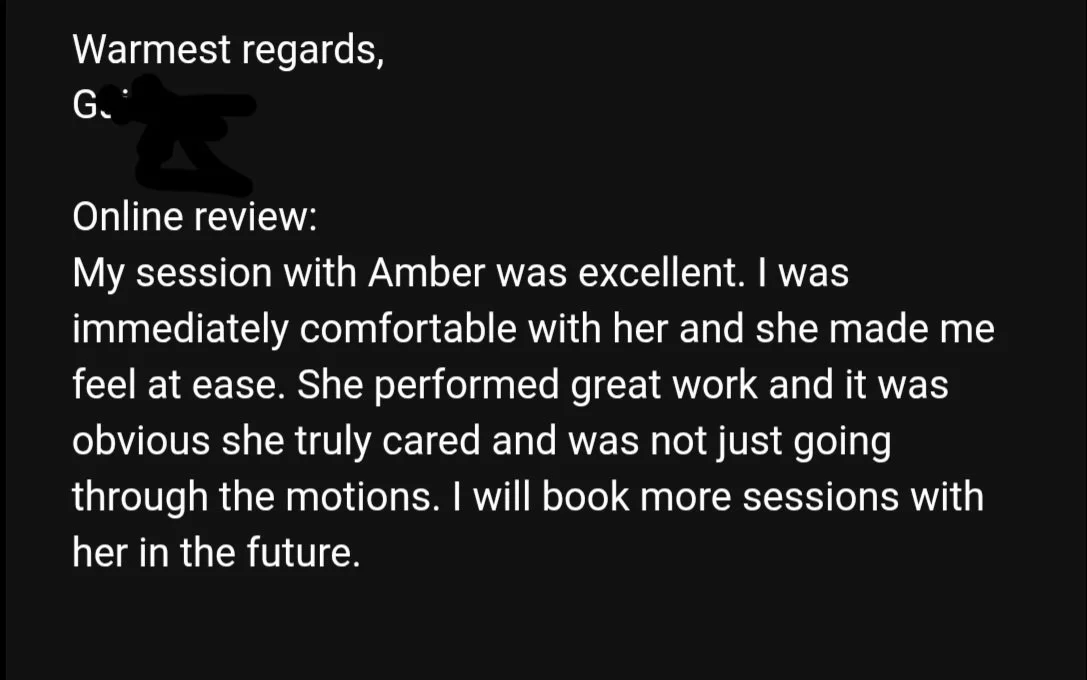
Recent An Intimate Evening with Spirit review 8.15.26
Learn to get out of your own way, dammit
I share this story with you to encourage you to get out of your own way as well. What’s preventing you from either showing up for yourself, engaging in anything you want to, or even allowing yourself to grieve, heal, and grow? Think about it. What is it? How are you going to challenge yourself to arrive? What do you need in order to go where you want and need to go? If you need help I gotchu. I have several options to provide support.
📞 Spiritual Consultation is a free service Healing with Amber provides to determine your spiritual needs, which ranges from spiritual counseling to spiritual development and readings (mediumship and intuitive tarot guidance).
Schedule your consultation here.
🌿 The Grief Sanctuary issacred space of resources Black, Brown, Indigenous, and Asian including weekly rituals, meditations, and or journal prompts to aid in their healing and spiritual developing journey.
Join membership here.
✨ The Inner Circle, is for Black, Brown, Indigenous, and Asian women who are ready for deeper, more personalized ongoing support.
Join membership here.
Join me this upcoming Wednesday where I discuss how’ve integrated spirituality within the clinical field. Until then, continuing moving with…
Care + intention,
Amber Choisella

Why Every Medium Needs to Understand Grief Clinically (Especially Unethical Mediums)
The Blind Spot in Spiritual Work That Hurts the People We're Trying to Help
There’s a gap in how a lot of Mediums are trained that nobody in the spiritual community talks about openly, and that gap produces real harm to grieving people who come to Spirit work at the most vulnerable moments of their lives. The harm is almost never intentional and it’s also almost entirely preventable because prevention requires something that most mediumship training programs don’t include, a working clinical understanding of grief.
This post is for two people simultaneously.
It’s for the clinician who’s been skeptical of spiritual work and has wondered whether practitioners without clinical training are causing harm they’re not equipped to recognize, and honestly the answer is sometimes yes, and you deserve to hear that acknowledgement.
This blog post is also for the woman who is grieving and who is considering attending a mediumship event or booking a reading, because what you’re walking into matters and you deserve to understand what training the practitioner has before you open yourself to whatever arrives in the session.
Note that is NOT a bash on ethical Mediums and the work that they do because just as there’s professional ethics in clinical practice there’s ethical training within mediumship development. As I write this post, I’m thinking that perhaps a psychoeducation training into learning how to identify complicated/traumatic/anticipatory/disenfranchised grief is important for Mediums. Stay tuned.
What Happens Without Clinical Understanding
When a Medium delivers a message from Spirit to a grieving person without understanding how grief works clinically, several things can happen that the Medium doesn’t intend and might not notice at all.
The first and most common is that the message lands in a way that interrupts the natural movement of the grief rather than supporting it, because grief moves in a non-linear, non-sequential way that requires specific conditions to process effectively, so a message that arrives at the wrong moment in the wrong framing can actually freeze the grief in a particular position rather than helping it move. The grieving person then leaves the session feeling something they cannot quite name, which is that the connection they sought made them feel temporarily better and then somehow worse, and they do not have language for why.
An example of this would be:
A woman attends a reading eight weeks after her mother's death, still in the acute phase of loss, and the Medium delivers an accurate message that her mother is at peace and wants her to stop being sad and move forward. The woman leaves feeling momentary relief and then goes home and feels worse without understanding why.
What happened is that the message delivered without clinical understanding of where she was in her grief process essentially told her grieving nervous system that her ongoing sadness wasn’t what her mother wanted, which she received not as reassurance but as a reason to suppress grief that hadn’t been felt or processed yet. Suppressed grief doesn’t accelerate healing but delays it which can create complicated grief over time.
A practitioner with clinical grief training knows that eight weeks is still acute and that even accurate spirit communication needs to be framed in a way that supports the natural movement of grief rather than interrupting it.
I would’ve said, “Your mother acknowledges how sad you are and the difficulty with dealing with her loss. She also makes me feel like she didn’t like attention focused on her and wants to remember you that she’s still existing just in a different form, and she’s worried that you won’t move on”, depending on the actual energy that is felt (say this was the personality of the woman’s mother). See the difference?
Second is that a Medium who doesn’t understand complicated grief, disenfranchised grief, or anticipatory grief can easily misread what a client needs from the session and deliver something that is technically accurate but emotionally harmful in its timing, framing, or its emphasis, because the communication of Spirit through a medium isn’t fully autonomous but is shaped in part by the Medium's own understanding of what the person needs. A medium without clinical training/professional ethics is working with an incomplete map of what grief requires. Professional ethics are included in mediumship development so although it’s not clinical training it is a positive direction in how to not cause harm for those seeking spiritual work for grief healing.
Third, and the one most likely to cause lasting harm, is that a Medium who doesn’t understand the clinical picture of complicated grief can fail to recognize when a client needs clinical intervention rather than or alongside Spirit communication, and can inadvertently become the primary support for someone who is in a genuine grief crisis, not because the Medium is irresponsible but because they simply do not have the training to recognize the clinical presentations that indicate a person needs more than spiritual work can provide. I have always recommended grief counseling/therapy during sessions when I noticed it would benefit my client.
The Overlap That Should Exist and Rarely Does
Clinical grief training and mediumship training are rarely taught in conversation with each other and they’re almost never integrated into a single coherent framework, even though the populations they serve are largely identical and the moments when they are needed most are almost entirely the same.
A grieving person who seeks out a Medium is doing so because they are in the middle of one of the most clinically significant experiences a human being goes through. The Medium who works with them is doing so without the clinical training that would allow them to hold that experience with the full understanding it deserves, and the clinician who could provide clinical work is often operating inside a framework that has no room for Spirit communication and therefore can’t prepare spiritual practitioners for the moment when the spiritual and the clinical are happening simultaneously in the same session.
The overlap that should exist between these two domains includes:
· A working understanding of how grief actually moves through the body and through time
· How to recognize the presentations that indicate complicated or traumatic grief
· How to hold the continued bonds with the deceased as a legitimate and often clinically supportive dimension of the grieving process rather than as a pathology to be redirected
· How to give accurate expectations about what spirit communication can and cannot offer a grieving person and
· How to know when to refer, which is the skill that most directly prevents the harm that untrained spiritual work can cause.
A medium who has this understanding is not only a better practitioner ethically but is also a more effective conduit for the communication itself, because understanding grief clinically changes how a practitioner holds the person in front of them, and how the practitioner holds the person changes the quality of what the session can produce.
What to Expect at An Intimate Evening with Spirit Event If You Are Grieving
What I want you to know is that this gathering was designed with you specifically in mind, because my training is clinical and spiritual simultaneously and my practice holds both without asking you to compartmentalize your grief into the parts that fit a mediumship session and the parts that belong somewhere else.
What you’ll find in that room is a practitioner who understands that you’re not simply curious about whether your person still exists somewhere, but that you’re grieving.
What you will not find is a performance or a spectacle or a practitioner who is optimizing for dramatic moments over truthful ones, because neither of those things serves a grieving person and I am not interested in either.
The Gap This Training Was Built to Close
The Psychospiritual Grief Method for BIPOC Clients Training on October 17th, 2026 was built specifically to close the gap I have been describing in this post, for clinicians who want to integrate spiritual literacy into their grief practice and for spiritual practitioners who want to ground their work in clinical understanding, because the gap is not a natural feature of how these two domains relate to each other but an artificial separation that has been maintained by professional culture and training convention rather than by any evidence that the separation serves the people seeking care.
If you’re a Clinician who is also a Medium, a spiritual healer, a tarot practitioner, or any other kind of spiritual support provider who works with grieving people, this training was made with you specifically in mind alongside the clinicians who are its primary audience, because the overlap the field refuses to teach is exactly what this methodology is built to provide.
Non-clinical spiritual practitioners, if you’re interested, I can create a psychoeducational training to provide insight into complicated and traumatic grief that you could refer to a psychospiritual clinician for additional support. Let me know, and I’ll create it.
Come Find the Support You Actually Need
📞 Free Grief Counseling Consultation for California residents who are navigating loss and want support that holds the clinical and the spiritual together rather than asking you to choose between them. Schedule at healingwithamber.co
✨ An Intimate Evening with Spirit event in Auburn, CA this Saturday August 15th, 6 to 7:30pm. This is an intimate in-person gathering held by a practitioner with both clinical grief training and advanced mediumship development, for women who want to experience what the integration of those two things actually feels like in a room. Space is limited. Register at here.
🎓 ThePsychospiritual Grief Method for BIPOC Clients Training, October 17th, 2026 is for clinicians who are ready to close the gap between clinical grief understanding and spiritual practice, with six CEs provided through the NBCC. Full details at healingwithamber.co/the-psychospiritual-grief-method-training
With care and intention,
Amber

Imposter Syndrome has me F*cked Up!
I’m no longer allowing Imposter Syndrome to hold me back with my mediumship.
To be real I’ve been I have been sitting with this for too long…. I’ve been hiding a while, hiding behind virtual events for mediumship because of imposter syndrome. It’s not that virtual events don’t work rather than I feel like it’s a form of shielding, hiding a part of myself out of fear that I’ll fuck up and not be able to deliver. That’s performative. Anxiety reminds me of the last group event I held where the first message was great, and I struggled through the rest. That was not only embarrassing, but it made me question my ability.
Note that this isn’t form of criticism of practitioners who work virtually, because I also work virtually. I just need to show up in a more meaningful way and truly connect with my community in a tangible way.
Facing my Fear Head On
This isn’t a post about my embarrassment, I mean, part of it is, but the majority is a testament to show up for yourself despite what Anxiety/Fear is saying to you. Being behind a screen for mediumship feels safe for me because of the distance between myself and the sitter. I can still feel the tenseness in the body when a nervous sitter enters the meeting room and I can see tears that well up when evidence is given that creates that connection, I’m striving to bring into the space, but it’s still different remotely.
Working in a group in person invites a realness that virtual events can’t. It’s an experience of trusting in Spirit whole-souly and being grounded enough not to be directly impacted by the sense of visible emotions in someone I could tap on the shoulder. That’s an intimacy that can be difficult to face head on if I’m stuck in my mind afraid of what wrong could happen while channeling. My issue is that I’m afraid of causing harm because that’s the worst-case scenario yet evidence has shown that I can deliver powerful and healing experiences through Spirit from previous in person events.
I remember the first time I was invited to come to a home and offer a “platform demonstration of mediumship” to a group of ten individuals from a previous client and was almost deathly afraid to even show up. I asked a male cousin of mine to accompany me because, I didn’t know these people, and that was his first or maybe second time witnessing me demonstrate mediumship. Guess what, I did a phenomenal job, so why wouldn’t I do another phenomenal job again?
If you’re struggling with showing up for yourself and doing THE THING… allow this post to be your evidence that you too can do it. Show up for yourself, especially if you work with Spirit, especially if what you want to do will bring something amazing to the collective.
Intimate as a Rebellion
Let’s talk about the pressure in the spiritual business culture that focuses on scaling, reach, and attracting the largest possible audience for any given offering… the fact of the matter is that virtual formats are the primary mechanism for achieving that scale, because virtual removes the geographic constraints and the logistical limitations that in-person work requires, and more people in more places can access what I offer.
I understand that pressure and I obviously have felt it, which has created a freezing factor which has hindered my growth and Healing with Amber’s growth, specifically pertaining to my mediumship work. Choosing an intimate and in-person event is, in the current spiritual business landscape is a mild form of rebellion because it refuses the logic that bigger and more accessible is always better and instead insists that some forms of healing require physical presence. A smaller number of attendees and a room that is sized to the depth of what is being held rather than for the scale of whom can attend hits harder than the quantity attendees who attend the event. Intimate is just that, intimate, and that’s what I’m offering in rebellion to Imposter Syndrome.
The only event I’m interested in creating isn’t the one that reaches the most folks but the one that actually reaches the people who are present and who are sharing the experience of witnessing and being witnessed by people who are physically present with you in the same sacred space.
What to Expect on August 15th, 2026
This Saturday August 15th from 6 to 7:30pm in Auburn, California, I’m holding An Intimate Evening with Spirit in-person mediumship event and I want to tell you exactly what that means before you decide whether to come.
The group will be small by intention, because small is what allows the work to go to the depth it is capable of going, and because the intimacy of a small room is itself part of the healing, not a logistical constraint but a deliberate choice about what kind of space this is.
The tone will be warm and grounded and unhurried, because mediumship at its best isn’t a performance. It’s a genuine attempt at communication across time and space that requires presence, patience, and the quality of attention that comes when a group of people have gathered with shared intention and are willing to be fully there for the full length of what the evening holds.
Not everyone will receive an individual message, because that’s the truth of how this work operates. Spirit isn’t a request service with guaranteed delivery, but everyone in the room will witness Spirit and it’s very possible that everyone could receive an indirect message because Spirit works in mysterious ways.
I just ask that all attendees arrive with openness rather than expectation, presence rather than an agenda, and willingness to allow the evening to be what it is rather than what any individual hoped it would be.
Come Be in the Room
This evening is for the woman who has been curious about mediumship and has not yet had an in-person experience, for the woman who has had readings before and knows she wants to be in a room rather than behind a screen, and for the woman who is simply drawn toward gathering with other women in sacred space and trusting what arrives when we do.
An Intimate Evening with Spirit
This Saturday, August 15th,
6 to 7:30pm,
Auburn, California.
Space is limited and intentionally so, and registration is required because the size of the group is part of what makes the work what it is, and once the room is full it is full.
🌿 The Grief Sanctuary Membership is for women who want ongoing community and monthly practices between in-person gatherings, because the connection that begins in a room like this one deserves a container to continue inside.
[Join the Grief Sanctuary Here]
With care and intention,
Amber Choisella

The Future of Grief Support Won't Choose Between Clinical and Spiritual Care
Something is shifting in the grief support landscape, and if you have been paying attention to where the field is moving, you already felt it, even if you don’t have the language for what you’re sensing.
You know that two coined system that created a Westernized mostly White (Males) organized grief support for the majority of a century, the one that created a clear separation between clinical care and spiritual practice. The “required” separation between the evidence-based, the ancestral, and between the therapeutic and the sacred, is now beginning to dissolve, not because the field suddenly decided to be more open-minded, but because folks are seeking grief support that meets the complexity of their actual experience.
This is where I make a prediction, which I would never do however, I believe that what I’m about to say is 100% accurate. There will be a shift occurring within mental health that will integrate and include spirituality for mental health treatment, because it’s already happening.
Why the Two Coin System Has Always Been Insufficient
The separation between clinical care and spiritual practice in grief support wasn’t inevitable, and it wasn’t based on evidence that one approach was more effective than the other for all folks in all contexts. It was actually the product of a particular historical moment in the 19th century when Western psychology was in the process of legitimizing itself as a science and distinguishing itself as clearly as possible from everything that could’ve been characterized as non-empirical, including spirituality, ancestral practices, and the communal dimensions of the human experience that didn’t fit inside an individualistic, secular, and materialist framework.
That distinction served certain professional and institutional interests, and it also left enormous gaps in the care available to grieving people, particularly BIPOC/BBIA folks whose cultural and ancestral understanding of grief, death, and the relationship between the living and the dead was never organized around that tow coin system in the first place.
For many BIPOC/BBIA communities grief has always been simultaneously psychological and spiritual, individual and communal, present-tense and ancestral, and the demand to choose between clinical support and spiritual practice in order to access either one has always been a demand rooted in a framework that wasn’t built with our experience in mind. The cost of that demand has been burdened by the folks who were already carrying the most.
What the Evidence Is Already Showing
The movement toward integrated grief support isn’t only a cultural or philosophical shift; it’s also being supported by a growing body of research that makes it increasingly difficult to maintain the binary system with intellectual integrity.
Research on meaning-making in grief has consistently demonstrated that the ability to find or construct meaning in loss, a process that is for many people fundamentally spiritual in nature, is one of the strongest predictors of adaptive grieving outcomes, which means that spiritual practice is not a supplement to effective grief support but a mechanism of it, and clinical frameworks that have no place for spiritual meaning-making are missing a clinically significant dimension of what helps.
The field of psychology is already discussing the impacting of integrating psychology and spirituality in reference to grief as evidenced by the article, The Integrated Process Model of Loss and Grief: An Interprofessional Understanding by Van den Berg, M., et al. (2023); however, The Psychospiritual Grief Method focuses on folks of Black, Brown, Indigenous, and Asian cultural backgrounds.
Research on intergenerational and ancestral trauma has established beyond reasonable clinical doubt that grief travels through generations and through both epigenetic and social transmission mechanisms, which means that a grief framework that locates the work entirely inside the individual client’s personal history is operating with an incomplete picture of what is clinically present in the room, and the ancestral and lineage dimensions of grief aren’t a spiritual addition to clinical work but a clinical reality that the work cannot fully address without them.
Research on somatic approaches to trauma and grief have demonstrated that the body holds what the mind hasn’t yet processed and that interventions that only work on the cognitive level leave the physiological dimension of grief largely untouched, which is exactly what many traditional talk-based clinical approaches have done, and why so many grieving folks report that therapy helped them understand their grief without ever quite reaching the place where it actually lived.
The evidence is pointing toward exactly the integration that a psychospiritual approach to grief has always held, and the clinical field is beginning, slowly and imperfectly beginning to follow where this evidence leads.
What the Future Actually Looks Like
The grief support model that’s going to define the next generation of care isn’t going to be the one that most closely resembles what the field has always done with minor cultural competency adjustments and it’s going to be the one that was built from the inside of the complexity it’s trying to hold.
It’s going to be built by practitioners who are clinically rigorous and spiritually literate, who hold their professional accountability and their ancestral and spiritual knowledge in the same practice rather than sequestering one from the other. It’ll be those who understand that evidence base practices and the wisdom of ancient traditions aren’tt in competition but are pointing toward the same truths about human experience from different directions.
It’s going to center the communities that have been most inadequately served by the existing model, BIPOC/BBIA communities whose grief has always been collective and ancestral as much as individual, who have always known that the two coined system was insufficient because their experience was never adequately contained by it.
It’s going to hold grief as sacred as well as psychological, as communal as well as individual, as ancestral as well as personal, and somatic as well as cognitive, because those dimensions are all present in every grieving person whether the clinical framework acknowledges them or not.
Why This Is Already Here
What I want to say to the folks in this community who are both the grieving women who have been searching for this kind of support and the clinicians who have been searching for this kind of framework, is that the future of grief support is no longer something you’re waiting for, because it is already here.
The Psychospiritual Grief Method wasn’t built as a prediction about where grief support is going, and it was built as a response to where it had already failed. The fact that the broader field is now moving in the same direction isn’t a validation of the approach, rather it’s a confirmation that clients who most needed something different were always right about what they needed.
The future of grief support looks like holding the clinical and the sacred without asking anyone to choose. It’s treating the lineage as part of the clinical picture rather than as background. It’s meeting grief in the body as well as the mind and bringing the full complexity of who a grieving person is into the room rather than leaving parts of her at the door because the framework wasn’t large enough to hold all of her.
That future is already available, and the women who are ready for it don’t have to wait.
Come Find the Care You Have Been Searching For
📞 Free Grief Counseling Consultation is for California residents who are ready to explore grief support that holds the clinical and the spiritual without asking you to choose between them, a consultation is where that conversation begins. [Book at www.healingwithamber.co]
🎓 Psychospiritual Grief Method Training — October 17th — for clinicians who are ready to stop improvising through the gaps and work from a framework that was built for the complexity their clients are actually bringing, this is the live training where the method becomes something you can use in your practice immediately, with 6 CEs provided through the NBCC, a small cohort by design, and direct access to Amber throughout. If you’ve been sensing that the field is moving toward this intersection and you want to be among the practitioners who are already there, this is where that positioning begins. [Register at healingwithamber.co/the-psychospiritual-grief-method-training
🌿 The Grief Sanctuary is ongoing space for weekly practices and a container built specifically for the future of grief support for women who are done with the binary and ready for something that holds all of who they are.
With care and intention,
Amber

The Ancestors You’ve Never Met Are Still Guiding You (How to Recognize Them)
You Don’t Need to Know Their Names to Feel Their Presence…..
You feel drawn to places you’ve never been. You have skills no one taught you. You know things without being told.
That’s them.
It’s not a coincidence or a quirk of personality and it’s certainly NOT something to brush past as interesting and then forget. The pull toward a specific landscape you’ve never stood in, the way your hands already knew how to do something the first time you tried, the inexplicable knowing that arrived before anyone gave you permission to trust it… these are points of contact. Your unknown ancestors, the ones whose names you don’t carry and whose faces you’ve never seen, are reaching toward you through the only channels they have: your body, your instincts, your unexplainable gifts.
You’ve probably felt them your whole life and called it something else.
Why the Ones You’ve Never Met Matter Just as Much
There’s a common assumption in ancestral work that only known ancestors count, that connection requires documentation, that you need a name to call on someone and receive something back. That assumption is wrong, and for many BIPOC women it’s also a form of harm, because it positions the deliberate erasure of lineage as a spiritual severing.
Your unknown ancestors are not less real because their names were taken, because records don’t exist, and because family memory doesn’t stretch far enough to reach them. They existed. They loved people and they carried knowledge, gifts, resilience, and a specific way of moving through the world that got passed forward, generation by generation, until it arrived in you. The documentation of their existence was never the source of their power. Their love was the source, and love does not require paperwork.
The ancestors you’ve never met may actually be the ones who work most actively to reach you, precisely because the connection was interrupted and they are determined to close that gap.
How They Show Up
You’ve already been receiving these signals. Here’s how to recognize them for what they are.
Unexplained talents in cooking, music, healing, or knowing/high psychic abilities. You made a dish for the first time and your hands moved like they’d made it a thousand times before. You picked up an instrument and something in your body already understood the rhythm. You sat with someone in pain and knew exactly what to say. These are not random gifts, they are transmissions, skills and sensibilities that lived in someone before you and that your body absorbed through the blood.
An attraction to specific places, particularly ancestral homelands. The inexplicable pull toward West Africa, toward a specific region of Mexico, toward land in the Deep South, toward a country you’ve never been to and whose language you don’t speak. Your nervous system recognizes something your conscious mind has no memory of. When a place calls to you with a longing that doesn’t quite make rational sense, pay attention. Someone from that land is calling back.
Physical features that seem to skip generations. You have your great-grandmother’s hands, the ones no one alive remembers except in an old photograph. Your bone structure echoes someone generations back. Your eyes carry a color or a shape that appeared seemingly out of nowhere. DNA is a record-keeper. Your body is a living archive of everyone who came before you, and sometimes that archive surfaces in the most literal, physical way.
Personality traits no one in your immediate family shares. You’re the only one who needs to be alone to recharge. The only one drawn to spiritual work. The only one who reads everything, who can’t stop making things with your hands, who has always had an inexplicable sense of justice. These weren’t invented by you. They were inherited from someone who didn’t have the conditions to fully live them, someone who passes them forward hoping you will.
Dreams of people you don’t recognize. A face that doesn’t belong to anyone in your life. An elder whose name you never learn. A woman who looks at you in a dream with recognition and love that moves you to tears. These are introductions. The unknown ancestors don’t wait to be formally invited once you open the channel. They show up, and they make themselves known through the most available portal there is: your sleeping mind.
Sudden, unexplained knowledge about cultural practices. You read about a specific ritual or ceremony and something in your body relaxes, like it was waiting to remember. You encounter a practice from your ancestral origin and feel not curiosity but recognition. This is cellular memory, the knowledge your lineage encoded in you before you were born, surfacing when the right context arrives to receive it.
The Specific Reality of Severed Lineage for BIPOC/BBIA Women
For many Black, Indigenous, and women of color, the absence of lineage records is not an accident and not a personal failure. It is the direct result of slavery, colonial displacement, forced adoption, immigration documentation barriers, and the deliberate erasure of names, languages, and family structures across generations.
This is a grief worth naming directly. The not-knowing is a wound, not a neutral fact, and it is also not the end of the story.
You do not need paperwork to claim your ancestors. You do not need a genealogy database to be in relationship with the people who made you. DNA memory is real. Epigenetic research continues to confirm what African, Indigenous, and diasporic spiritual traditions have always known: trauma, knowledge, and survival strategies are encoded in the body and passed forward. What was carried in your ancestors is still being carried in you, not as metaphor, but as biology.
Spiritual connection transcends documentation. The ancestors you cannot name are not waiting for you to find them in a record. They are already present in you. The work is not to locate them. The work is to turn toward them.
How to Begin Connecting
You don’t need their names. Here’s what you use instead.
Call in “those who came before me” without specification. Broad, open, and honest. You are not pretending to know what you don’t know. You are simply making yourself available. Try: “I call in all ancestors who are healed, who love me, who walked before me, known and unknown. I am here. I am listening.”
Use cultural or geographic origin as the bridge. If you know your lineage connects to the African diaspora, to Indigenous lands of Turtle Island, to the Caribbean, to Latin America, to Southeast Asia, name that. The land holds memory. The lineage recognizes itself even when specific names are lost. “I call in my West African ancestors, those who crossed the water and those who never left the shore.”
Trust what you’re drawn to without demanding explanation first. The food you make without recipes, the music that opens something in you, the spiritual practices that feel like recognition rather than learning. Follow these threads. They are trails your ancestors left for you.
Let them introduce themselves in dreams. Before sleep, say simply: “If any ancestor who loves me wishes to make themselves known, I am open. Come.” Then trust whatever arrives, even if it doesn’t look like what you expected. Write it down before the day erases it.
The Medicine of Mystery
Not knowing names doesn’t weaken the connection. There is something powerful in the open call, in the invocation that asks not for a specific person but for all who love you, all who walked before you, and all who are ready to guide you now.
Your unknown ancestors are not diminished by anonymity. They are, in some ways, freed by it. You can’t project onto them what you knew of them in life. You can’t carry complicated grief about their choices. You receive them as pure lineage, as the unfiltered love of those who want your flourishing without the weight of personal history.
Your blood remembers what your mind forgot…. so let that be enough to begin.
Come Closer This Month
💛 Free Grief Counseling Consultation is for California residents who are ready to explore grief support that holds the clinical and the spiritual without asking you to choose between them, a consultation is where that conversation begins. [Book at www.healingwithamber.co]
🌿 The Grief Sanctuary: Monthly ancestral practices, ritual guides, and a community of BIPOC women doing this work together. If this post opened something in you, the Sanctuary is where the ongoing connection lives. [Join here]
🕊️ An Intimate Evening with Spirit Event August 15th, 2026 Auburn, CA: Come connect with your ancestors/loved ones in person. I’ll be holding space for ancestral healing and spiritual connection in an intimate in-person gathering. [Reserve your spot]
With care and intention,
Amber Choisella
What It Actually Feels Like When Spirit Comes Through from a Psychic Medium
Most folks come to their first mediumship reading expecting something dramatic and most people leave surprised by how quiet, precise, and deeply physical the real experience actually is.
TV built a particular image of mediumship that has very little to do with what genuinely happens when spirit communication occurs. You know, all the dramatic revelations, theatrical moments, and the convenient delivery of exactly what the grieving person most needs to hear in the most emotionally impactful sequence possible… Just know that production does what it does to create compelling entertainment. They have to keep the entertainment going but in all actuality it’s a real disservice to the folks who arrive at a reading with that template as their reference point.
This blog will discuss what it actually feels like, from my side of the reading and from the side of the people who have sat across from me, because I think the honest account is both more interesting and more useful than the dramatized one.
What It Feels Like From My Side
Spirit communication doesn’t arrive like a voice from outside, projected into the room from a specific direction and audible for everyone present, nope. It arrives more like a knowing that lands in the body before it reaches the conscious mind, a shift in the quality of the internal environment that is distinct from my own thinking in a way I have learned, through years of development and training, to recognize and trust.
It often begins with sensing an energy whether dominantly feminine or masculine, then the relationship, before the personality. I see energy as though it’s being projected to me from behind and brought to the front of my awareness. That’s the best way that I can explain it, rather like an impression of how they want to present. I allow myself to connect more with their energy and ask them to come closer to receive rather than try. Trying happens when I get in my own way. Working is allowing Spirit in to share what they want me to share. The evidential occurs throughout this time and discernment is a learned skill in how I differentiate between my energy and the energy of Spirit, collectively.

The brightness reminds me of Spirit energy.
Although the moments of clearest connection have a particular quality that I can only describe as alignment, when what I’m receiving, what I’m saying, and what’s landing for the person across from me are all moving in the same direction at the same time, and in those moments something in the room shifts in a way that’s palpable to everyone present. The information that comes through in those moments tends to be the most specific, the most evidential, and the most impossible to attribute to generalization or lucky guess.
Most importantly know that before each and every session or event I ask for only loved ones who have had good relationships with the sitter and are good communicators to come in, because boundaries are absolutely necessary in this work.
What It Feels Like From the Other Side
The folks who have sat across from me describe the experience in several recurring ways that are worth naming, because they may be useful to someone preparing for a first reading or trying to make sense of a reading they have already had.
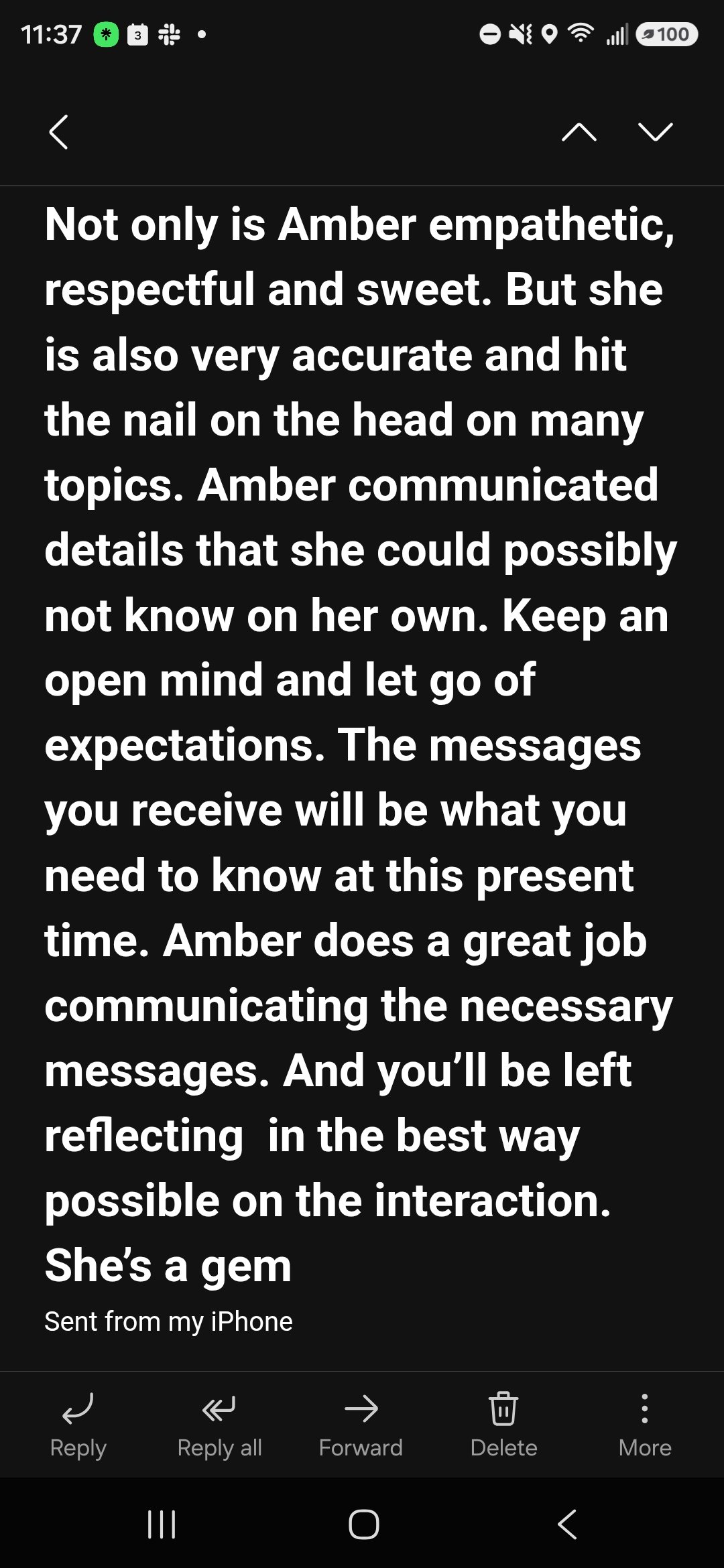
This was the funniest Spirit I’ve interacted with in a very long time. April 2026.
Prior clients have described a physical response before they have consciously registered what was said or even an experience of feeling a sudden welling of emotion or a warmth in the chest that arrives in the same moment that a specific piece of information is offered. Physical response is often the most reliable indicator that something genuine is occurring, because it’s too immediate to be the result of rational processing.
The most commonly reported experience isn’t the one folks expect, which was a dramatic confirmation of everything they most hoped to hear, but rather the arrival of something specific and unremarkable that only they could recognize, a particular word their person used, a detail about a specific object or memory or habit that had no place in any generalized description of grief, and the specificity of that detail is what makes it evidential, because it could not have been generated by a general understanding of what grieving people need.
Clients have also described the experience of feeling the presence of their loved one outside of simply receiving information about them, and this presence is often described along with an emotional quality that belonged to their loved one in life, and some even describe a particular kind of warmth or humor or steadiness that is recognizable even when it is not being articulated in words.
What Spirit Communication Is NOT
It’s not a performance and it’s not a guaranteed delivery of exactly what you came for, because neither of those things is in my control or in yours. You need to know that the communication is guided by whatever wisdom governs what the person on the other side offers and what serves the person receiving the reading in that specific moment.
It’s not always comforting in the immediate sense, because sometimes what comes through is challenging, clarifying, or pointing toward something you as the client has been avoiding. A reading that delivers only comfort without ever pointing toward anything difficult is a reading that may be reflecting the Medium’s wish to please more than the actual communication of Spirit, which is an experience you won’t have with me.
It’s also not a substitute for grief, because the connection confirms the continuation of the relationship but it doesn’t replace the process of moving through the loss, and the women I work with who receive the most from mediumship readings are the ones who are also doing the grief work alongside the spiritual work, not using one as an escape from the other.
Again, no spiritual bypassing bullshit here.
If You’re Considering a Reading
What I want you to know before you sit across from me either in person or virtually is that I will bring everything I’ve developed over 16 years of training, practice, and continued development to the session. You need to know that what arrives will be guided by something larger than either of our intentions, and that whatever comes through will be offered with full ethical accountability and full commitment to your wellbeing as the person receiving it.
I would also want you to know that the most open you can come and the less tightly you hold a specific expectation about what the reading should deliver, the more available you’ll be to receive what is actually present rather than evaluating everything against what you came hoping for.
Book a Reading or Come Find Us
🕊️ Mediumship Reading with Amber 30 minutes or 1 hour, evidential, ethical, grounded in advanced training at the Arthur Findlay College and continued mentorship with experienced mediums, available worldwide. [Book at www.healingwithamber.co for your free consultation]
🕊️ An Intimate Evening with Spirit in person mediumship group event will be held on Saturday August 15th in Auburn, CA. Tickets are $65 and the event will be from 6-7:30pm. If you’re in the area and interested, purchase tickets now. Only 10 attendees will be allowed. Click here to purchase your ticket.
🌿 The Grief Sanctuary is where the spiritual and the grief work are held together in ongoing community and monthly practice, for women who want to continue the connection and the healing beyond any single reading. [Upgrade Subscription]
✨ The Inner Circle is for women who are ready for deeper, more personalized ongoing support and access to Amber as you continue the work. [Upgrade Subscription]
With care and intention,
Amber Choisella

The Part of Healing Nobody Warns You About: Grieving Who You Had to Be to Survive
Nobody tells you that healing will also feel like grief.
Folks tell you about the relief, expansion, the eventual return back to yourself, and the clarity that arrives when you finally put something down that has been heavy to carry……all of those things are true, but they’re not the whole truth. The part that gets left out is the part that catches most people off guard.
When you release a survival strategy you’ve been carrying for years or decades and begin to put down the armor that kept you alive through these conditions, something that functioned as part of you dissolves, and that dissolution is a loss, and loss produces grief, and that grief is real even when the releasing was necessary.
This is one of the most important and least discussed paradoxes of healing, and I want to talk about it directly because I have watched too many women interpret the grief of their own becoming as evidence that something has gone wrong, when it’s actually evidence that something is going exactly right.
Why Healing Triggers Grief
To understand why healing produces grief, it helps to understand what survival strategies actually are and what they actually do.
Survival strategies aren’t character flaws or pathologies, and they’re not evidence that something was wrong with the person who developed them. Survival strategies whether maladaptive or healthy were developed in response to conditions that required them.
The hypervigilance that kept you safe in a household where safety was unpredictable, the smallness that protected you in environments where being visible was dangerous, the over-functioning that gave you a sense of control in situations where control was otherwise impossible, and the suppression of emotion that made it possible to keep going when falling apart would’ve had perceived real consequences. These weren’t mistakes and they weren’t weaknesses. Remember that these things aren’t meant to be ashamed of because they were the specific and brilliant adaptations of a person doing what was necessary to survive something truly difficult.
The problem isn’t that you developed survival strategies because developing them was the right response to the conditions that produced them, and the problem is that they don’t update themselves automatically when the conditions change, so what was once protection becomes a cage, and what once kept you safe begins to keep you from the life that is possible now after the threat has passed.
When you begin to release a survival strategy, you aren’t only releasing a behavior pattern or a way of thinking, you’re releasing the version of yourself who needed that strategy. What is happening now is that you’ve become to shift toward something truer.
Healing triggers grief because becoming something different means something else ends and endings are losses. Understand that losses require grief and there’s no shortcut through that process, even when the ending is the one you have been working toward.
The Psychospiritual Cost of Outgrowing Survival Identities
For BIPOC/BBIA women specifically, the survival identities that are most commonly in need of releasing carry a particular weight because they weren’t developed in a vacuum, but instead as a response to systems and conditions that were dangerous and releasing them can feel not only like personal loss but also like a betrayal of the lineage that needed those strategies to survive.
The armor of the Strong Black Woman, the suppression of need and vulnerability and softness in service of family, community, and every person in the room except herself, wasn’t invented by individual women. It wasn’t a personal choice made from personal weakness, but an adaptive response to conditions that left Black women with no other viable option, because being seen as weak or needy or in need of care carried real consequences in a world that wasn’t designed to hold their/own fragility.
The permission-seeking that learned to make itself small, acceptable, and unthreatening in white-dominated spaces wasn’t a failure of confidence but a legitimate cost of being too much in environments that had made those costs clear, and the unlearning of that permission-seeking, even when it’s entirely necessary and entirely right, can feel like stepping into open air without knowing where the ground is.
The smallness that kept you safe in your family of origin, in your religious community, in the early professional spaces you navigated, that smallness has its own identity, its own relationships, its own familiar shape in the world, and when you begin to take up more space, the disorientation of the new size is real even when the new size is the right one.
Outgrowing a survival identity means grieving the person who wore it and that person deserves to be grieved, because she kept you alive, and she deserves to be honored before she’s released. She carried what she could with what she had, and she was doing her best under conditions that asked too much of her.
Honoring Who You Had to Be
This is the piece that most healing frameworks skip, because the cultural narrative around healing is organized around release and moving forward and leaving behind, and it doesn’t make room for the truth… that what you’re leaving behind was a real person who did real things and deserves a real acknowledgment before you go.
The woman who made herself small deserves your gratitude, because she read the room accurately and adapted accordingly. She protected you in the ways available to her, and the fact that you’re now in a position to outgrow that smallness is in part because she did what she did when she needed to do it.
The woman who suppressed her grief and kept going deserves your compassion, because moving forward was a perceived necessary, and the suppression was the price of moving forward. Judging her for that cost of her own survival is a form of abandoning her, and she deserves better than abandonment from the woman she became.
Gratitude and release can coexist in the same breath. Healing that honors both is more complete than the healing that only celebrates what’s being gained without acknowledging what’s being given up.
This Isn’t Regression. This Is Completion
When the grief of healing arrives and you find yourself mourning the identity you’re releasing or the relationships that are shifting, the most important thing I can tell you is this, what you’re experiencing is not evidence that you are moving backward.
Regression and completion can feel identical from the inside because both involve returning to something that was previously present, but regression is a return without integration and completion is a return with it. The grief of becoming is almost always completion rather than regression, because it’s the finally arrived acknowledgment of a loss that was always real but was never given adequate room.
The grief of letting go of your survival strategies is the last act of honoring them before you put them down, and it’s the first act of the liberation that comes after. This belongs in the process not as a complication of the healing but as an essential part of it.
Grief isn’t an obstacle rather grief is a passage, and this passage requires you to feel it fully rather than managing it efficiently, because what’s on the other side of it isn’t available through any other route.
You Aren’t Going Backward
You’re completing something that needed to be completed before you could go where you are actually going, and the woman who wore the armor and kept going and made herself small, who suppressed her grief and kept everyone else together isn’t someone to be ashamed of or outrun or left behind. She’s someone to be thanked, held, and released with the same quality of care and presence that you’re now learning to give to your grief, because she earned it, and she’s the reason you’re here to do the releasing.
Support for the Passage
🌿 The Grief Sanctuary is for women navigating exactly this kind of grief, the grief of becoming, the loss of survival identities, the disorientation of taking up more space than you were taught to take, with weekly practices and a container that holds every phase of the arc. [JOIN HERE]
✨ The Inner Circle is for women ready for deeper, more personalized support as the survival identities dissolve and the emerging self needs more than monthly practices to hold. [JOIN HERE]
📞 Grief and Spiritual Counseling is for one-on-one support in moving through the grief of healing with both clinical grounding and spiritual wisdom, because this particular passage deserves a practitioner who can hold the full complexity of what it asks. [Book at www.healingwithamber.co →]
With care and intention,
Amber
You Shouldn't Be Charging for Spiritual Gifts You Haven’t Trained for Yet
I’m going to say something that will make some folks uncomfortable….
Having a spiritual gift isn’t the same as being qualified to offer it to others for compensation. The two things are related but they aren’t identical and the gap between them is where a significant amount of harm in the spiritual healing space is quietly happening.
This post isn’t a critique of anyone specific, but rather a conversation about ethics, accountability, and what genuine spiritual development actually requires, and it’s also, a story about my own journey through that process, because I don’t think I have standing to talk about this without also naming what I have invested in my own development.
What I Did Before I Called Myself a Medium Publicly
In October 2019, I attended the Arthur Findlay College in Stansted, England for Advanced Mediumship training.
https://youtu.be/Ymbck7yoTK4?si=rQMBbZO4yuB1fRSR
Watch my 2019 vlog of attending the Arthur Findlay College.
If you aren’t familiar with the Arthur Findlay College, it’s widely considered one of the most rigorous institutions in the world for mediumship development and spiritual education, and it’s not a weekend workshop or an online certification, but an intensive residential training environment with a long history of serious spiritual education, where working with the evidence and with the ethics of mediumship is treated with the same rigor that clinical training applies to therapy.
I documented that experience on my vlog, up above. I want you to know that this type of training exists. I want you to understand that when I talk about the ethics of training, I’m not talking abstractly. I’m talking about something I invested in and continue to invest in within real time, real money, real vulnerability, and real surrender into before I offered mediumship professionally.
That training at Arthur Findlay wasn’t the beginning of my development. It was a milestone within a longer journey that included ongoing work with experienced mediums, continued mentorship, consistent practice with ethical accountability, and the sustained commitment to developing the gift rather than simply expressing it.
I still train and develop, because the learning doesn’t end when the practice has begun, and if anything, the deeper the practice goes, the clearer I become. I understand how much there is still to learn and how important it is to keep learning it.
The Arthur Findlay College isn’t the only organization to develop with. We cannot forget about ancestral practitioners in which practices are passed down through cultural trainings. Those are just as important too.
What Ethical Spiritual Development Actually Requires
I want to be specific here because vague calls to “do the work” are easy to dismiss. Here is what I mean concretely.
Mentorship with someone who’s more developed than you, not a peer accountability group or a community of people at the same level of development all confirming each other’s experiences, but someone who has been doing this longer, who can see what you can’t yet see about your own practice, and who will tell you the truth about where your discernment is unclear or your ego is interfering or your gift is not yet ready for a specific kind of work.
Structured training in the specific modality you intend to offer, because mediumship has a body of practice, a set of ethical guidelines, and a tradition of development that has been refined over generations, just as tarot has its own depth of study, and energy healing modalities have their own requirements. Innate abilities open the door while training is what teaches you to walk through it without causing harm.
Ethical accountability for what you offer and how, which means being honest about what you can and can’t do, giving accurate disclaimers before readings (Just like this transparent blog I recently wrote) knowing the difference between what you genuinely received and what you wanted to receive or what the client needed to hear, knowing when a situation requires clinical support rather than or alongside spiritual support, and knowing when to refer out.
Continued development even after you have begun practicing, because the practitioner who stopped developing the moment they started charging isn’t a practitioner who’s honoring the gift and development isn’t a precondition for practice that you complete and then move past, nope, it’s a lifelong commitment that is part of what makes the practice what it is.
Honest self-assessment, which is the hardest of all, because it requires you to ask regularly and without defensiveness whether what you’re offering is actually coming from your clearest channel or from something less clear. It’s also very important to know whether your discernment is reliable, knowing if you’re operating inside your actual scope, and asking yourself whether your clients are being served or being harmed by what you offer.
Why This Matters for the People Who Sit Across From You
Every person who sits across from a medium or a spiritual healer is in some form of vulnerability, having come because something in their life has broken open, whether that it’s a death, a loss, a spiritual crisis, or a question about who they are or what their life means, or whether the person they loved still exists somewhere they can reach.
That vulnerability isn’t something to be exploited, even unintentionally. This is easily exploited by practitioners who haven’t done enough development to know the difference between what they’re genuinely receiving and what they are projecting. Who have not developed enough discernment to know when a client needs to be referred to clinical support. Who have not built enough ethical infrastructure around their practice to hold themselves accountable for the impact of what they offer.
The harm that comes from an underdeveloped spiritual practice that’s often invisible looks like this:
The client who received an inaccurate reading about her deceased mother and organized her grief around it.
The person who was told something specific about their health that was not true and made decisions based on it.
The woman who was kept in an emotionally dependent relationship with a practitioner because the practitioner’s unresolved need for significance was being met through the dynamic.
These things happen, and they happen less when practitioners take their development seriously.
The Spiritual Community’s Resistance to This Conversation
I know this conversation is uncomfortable because I have watched it make people uncomfortable when I’ve approached it before.
There’s a framework in some spiritual communities that suggests that the gift, because it comes from Spirit, is inherently ethical in its expression and that if the intention is love, the outcome will be love. Some believe that requiring training or accountability is somehow a Western, institutional imposition on a natural spiritual capacity.
I disagree with that framework, and I disagree with it specifically because I have seen the harm it produces and it’s bullshit.
The gift is real and the love behind the offering is real, but neither of those things are sufficient protection against the harm that comes from underdeveloped discernment, poor ethical boundaries, and/or practice offered before the practitioner is ready, because love and good intention are the beginning of ethical spiritual practice, not the entirety of it.
What I Offer and Why I Believe I’m Ready to Offer It
I offer mediumship readings not because the gift arrived and I began offering it. I offer them because I have invested 16 years of structured development, rigorous training at the Arthur Findlay College, ongoing work with experienced mediums, and consistent ethical accountability into developing the gift before and alongside offering it.
I offer spiritual development mentoring not because I have arrived somewhere perfect but because I have walked the specific path of developing these gifts with integrity and I know what that path requires and where its difficulties live.
I offer grief counseling not because mediumship and clinical work feel naturally connected but because I have done the specific work of integrating them, ethically, rigorously, and with full accountability to both the clinical and the spiritual standards that govern each.
I’m telling you this because I think you deserve to know what’s behind the offer before you accept it.
Book With Someone Who Has Done the Work
🕊️ Mediumship Reading with Amber 30 minutes or 1 hour. Evidential, ethical, grounded in years of rigorous development including training at the Arthur Findlay College and continued mentorship with experienced mediums. Available worldwide. [Book at www.healingwithamber.co]
🔮 Free Spiritual Consultation if you’re navigating spiritual experiences, developing your own gifts, or exploring what spiritual development mentoring could look like for you, the consultation is where we start. [Book at www.healingwithamber.co]
🌿 The Grief Sanctuary is ongoing space and monthly practices for women at the intersection of grief and spiritual development. [Join at $27/month at upgrade here]
✨ The Inner Circle is for women who are ready for deeper, more personalized ongoing support and access. [Upgrade Subscription]
With care and intention,
Amber Choisella

This Is Exactly How I Guide Someone Through Grief in the First 8 Weeks
Most grief support gives you coping tools.
You know that list of strategies for hard days you’re given, or breathing techniques for when the wave hits. Also, you’ve assigned journaling prompts to work through the cognitive dimensions of loss. Resources for the practical aftermath of death or divorce or the ending of whatever organized your life before.
These things aren’t without value, but they’re not what I do. If you’ve experienced that kind of grief support and felt like something essential was still not being reached, I want to tell you exactly what a different approach looks like, in practice, week by week, so that you can recognize the difference between grief support that manages you and grief support that actually moves you through something.
What follows is a map of the first eight weeks of psychospiritual grief work. The actual arc of how I guide women through the beginning of this process, and what each phase is designed to hold.
Two People Reading This
This post is for the woman wondering whether or not this approach is right for her and what she would actually be walking into.
This post is also for the clinician who has been searching for a more culturally grounded and more spiritually literate framework than what their training provided who wants to understand what this method looks like in lived practice before they commit to learning it.
Both of you deserve to know exactly what this work is. Here it is.
Phase One: Witness (Weeks 1 through 3)
The first phase of this work isn’t about moving anywhere. It’s about arriving.
Most grieving women who come to this work have spent significant energy managing their grief before they get here. Managing it for their families, who needed them to be functional, for their workplaces, which had a limited window of accommodation, for their communities, which had a cultural script about how long grief was supposed to last and what it was supposed to look like, and managing it for themselves, because the full weight of what they were carrying was too much to feel all at once without a container strong enough to hold it.
The first three weeks are about building that container and stopping the management.
In practice this means creating the conditions for a grieving woman to bring the full version of what she is carrying into the space, often for the first time. The grief that is ancestral and collective as much as it is personal. The spiritual dimensions of her loss that she has been carrying privately because no one in her life knew what to do with them. The anger that has been mislabeled as something more acceptable. The relief she has been ashamed to feel. The love that has nowhere to go.
Witnessing isn’t passive. It’s the active, skilled practice of being fully present with what someone is carrying without trying to redirect it, reframe it, fix it, or move it toward resolution before it has been fully seen. For BIPOC/BBIA women who have rarely if ever had this quality of presence offered to their grief, the experience of being genuinely witnessed is itself a significant intervention. Something physiologically shifts when a person feels that their full experience, including the parts they have been managing, is welcomed into the room.
For clinicians: the witness phase requires you to suspend the impulse to intervene. The instinct to offer a reframe, a coping strategy, a normalizing reflection, is strong. In this phase, the most powerful clinical move is often the one you don’t make. You stay. You hold and allow the full weight of what your client is carrying be present without immediately organizing it into a clinical framework. The framework comes later. First, she needs to know that the full picture is welcome.
Phase Two: Integrate (Weeks 4 through 6)
Once the grief has been witnessed and the container has been established, the work shifts. Phase two is integration, and it operates across all three pillars of the Psychospiritual Grief Method simultaneously.
Psychologically, integration means beginning to make sense of the loss inside the full context of the client’s life, including the ancestral and cultural context that shaped what this loss means and how it is being metabolized. This is where the lineage work begins in earnest, locating the current loss within the larger arc of what the client and her lineage have already survived and what they’re carrying from before.
Spiritually, integration means bringing the spiritual dimensions of the grief into the clinical work rather than treating them as separate. We integrate dreams, signs, and the sense of continued presence or its painful absence. The religious or spiritual identity that may have been disrupted by the loss. The ancestral practices that the client has been reaching toward without knowing their names. This is where the somatic and spiritual work deepens: altar practices, journaling as prayer, breathwork as a container for what the body is holding.
Somatically, integration means beginning to move what the body has been storing. Grief does not resolve through cognitive understanding alone. It lives in the chest, the throat, the belly, the held breath, and it requires practices that can reach those locations directly. The somatic work in this phase isn’t about forcing release. It’s about making contact, again and again, with what the body has been holding and creating the conditions for it to move when it is ready.
For clinicians: integration is where the full Psychospiritual Grief Method framework becomes most active. This phase requires you to hold the psychological and the spiritual and the somatic simultaneously, which is exactly what standard clinical training did not prepare you for. It is also where clients begin to show the most significant movement, which can be both exhilarating and challenging to hold. Having a rigorous framework for this phase changes what is possible.
Phase Three: Reimagine (Weeks 7 and 8)
The third phase doesn’t arrive because the grief is finished. It arrives because the client has developed enough relationship with her grief that she can begin to hold a second question alongside it: who am I becoming on the other side of this?
Reimagining is not the grief equivalent of toxic positivity. It doesn’t ask the client to silver-line her loss or create meaning before meaning is genuinely available. It’s the natural emergence of a self that has been witnessed and integrated rather than managed, a self that has more room than it had before the work began, because the weight that was being suppressed has started to move.
In practice, reimagining looks like this :
A client who begins to speak about her loss with a quality of presence that includes grief and something else alongside it.
A woman who starts to articulate, for the first time, who she is outside of the roles and identities that the loss disrupted.
A practitioner-client who begins to see how her own grief has been calling her toward a specific kind of work.
A woman who picks up something she put down years ago, or puts down something she has been carrying for generations, because the eight weeks have created enough internal room to make a choice that was not previously available.
This phase isn’t the end. Eight weeks of psychospiritual grief work is a beginning, not a completion. What it offers is the foundation, the established container, the developed relationship with grief as something that can be moved through rather than managed indefinitely, from which everything that comes after can grow.
For clinicians: reimagining requires you to hold the emergence alongside the grief without rushing the client toward resolution. The new self is fragile in the first weeks of its arrival. Your role is to witness the emergence with the same quality of presence you brought to the grief itself, without collapsing the complexity into a narrative of recovery that isn’t yet fully true.
What This Work Isn’t
It’s not a program that promises to complete your grief in eight weeks. Grief doesn’t complete on a timeline.
It’s not spiritual bypassing dressed up in clinical language because the psychological work is real. The somatic work is specific, and the spiritual framework is held with ethical accountability.
It’s not one-size-fits-all support with a culturally diverse logo. The framework was built from the inside of BIPOC/BBIA women’s grief, by a Black woman who is a clinician and medium who grieved without a roadmap and built one from what she found in the dark.
It’s the beginning of a relationship with your grief that changes how you carry it. That is what eight weeks can do when the work is right.
Take the Next Step
For clients: If what you read here describes what you have been looking for and haven’t been able to find, a free grief counseling consultation is available for California residents. This is where we talk about what you’re carrying and whether this work is the right fit for you. [Book at www.healingwithamber.co]
For clinicians: The Psychospiritual Grief Method Training gives you the framework to guide clients through exactly this arc, with the clinical and spiritual rigor this work requires. Six CEs. Small cohort. Enrollment is open. [Full details at www.healingwithamber.co/the-psychospiritual-grief-method-training]
🌿 The Grief Sanctuary for women who want to begin this work with guidance who are moving through every phase of the arc. [Upgrade your Subscription]
Subscribe now
With care and intention,
Amber

Your Spiritual Gifts Are Terrifying You and That’s Exactly How They’re Supposed to Arrive
You felt something you weren’t supposed to be able to feel. You knew something before it was possible to know it. You saw something in a dream that then happened. You sensed a presence so clearly that the rational explanation stopped being convincing, and the one that replaced it scared you more.
Your first instinct wasn’t wonder. It was fear.
That response is not a sign that something is wrong with you. It is, in fact, one of the most reliable indicators that something real is happening.
Why Emerging Gifts Feel Terrifying
Spiritual gifts, when they’re emerging, don’t usually arrive with a soft welcome or a clear instruction manual. They arrive in the gap between what you thought was real and what you’re suddenly experiencing. They land in the nervous system before the mind has a framework to receive them, which means the nervous system often responds the way it responds to any unknown, with alarm.
The gift doesn’t feel like a gift when it first arrives. It feels like something happening to you without your permission kinda like a curse… It can and does feel like that at time because you start seeing things you didn’t ask to see and knowing things you didn’t ask to know. You’re being affected by other people’s emotional states so acutely that you can barely distinguish/discern their pain from your own. You could also be receiving information in dreams or in waking moments that turns out to be accurate in ways you can’t explain.
These experiences are disorienting. The disorientation is not evidence that you are broken. It is evidence that your capacity is larger than the container you’ve been living inside, and that the container is in the process of expanding.
Fear Versus Reverence
There is an important distinction worth making here, between the fear that signals danger and the fear that signals the sacred.
Not all fear is a warning to retreat. Some fear is the body’s way of recognizing that something significant is happening, something that asks for a different quality of attention than ordinary experience requires. Many spiritual traditions same the belief that the shaking in the presence of something holy is not the same as the shaking in the presence of something threatening, even when both feel like fear in the body.
The fear that says “I am in danger” is usually accompanied by a desire to flee, to close, to protect. The reverence that looks like fear is often accompanied by something underneath it that wants to move closer, even when the surface of you is frightened. The awe that is on the other side of the alarm.
Learning to tell the difference is part of the work of living in relationship with gifts that are larger than you initially knew how to hold. You don’t have to be fearless. You just have to be willing to get curious about what the fear is actually pointing toward.
What Was Taken, What Is Being Reclaimed
For BIPOC people, the terror around spiritual gifts carries a layer that is worth naming directly.
Your ancestors had these gifts. The woman in your lineage who was called a healer, a dreamer, a medicine woman, a seer and the traditions your people practiced before colonization, before forced conversion, before the calculated destruction of Indigenous spiritual systems and the criminalization of African and Afro-Caribbean religious practice. The gifts that existed in your bloodline for generations before they became dangerous to express.
Suppression isn’t ancient history. The Yoruba religion was actively persecuted across multiple continents well into the twentieth century. Curanderismo and Indigenous ceremonial practice were interrupted through residential schools and forced assimilation within living memory. The “Strong Black Woman” framework that forbids vulnerability also, conveniently, forbids the kind of softness and receptivity that gifts require.
What you’re experiencing as terrifying might be, in part, a cellular memory of the cost of these gifts. Your nervous system holds the history of what happened when the women before you were seen with these abilities. The fear is not only yours, but some of it is also inherited and inheriting it does not mean you are required to stay inside it.
These gifts weren’t destroyed by suppression because they went underground. They moved through the bloodline in forms that were harder to name and easier to survive with. They are surfacing now in you, in part because you are living in conditions where it is finally safe enough to surface.
Common Experiences That Terrify People
If you are wondering whether what you’re experiencing counts, here is what I hear most often from the women who find their way to this work:
Knowing something about a person the first time you meet them, information you had no logical way of accessing.
Feeling other people’s emotions in your own body with such acuity that crowds become overwhelming and some people leave you depleted in ways that have nothing to do with what was said.
Dreams that contain specific, accurate information about things that then happen.
A sense of presence in rooms that feels distinct from imagination.
Hearing a name, a word, or a phrase clearly in the space between sleeping and waking.
A sudden and inexplicable knowing about a situation or a person that turns out to be true.
These are'’t symptoms. They’re capacities and that distinction matters.
Why the Gifts Are Emerging Now
Grief is one of the primary activating conditions for spiritual gifts. This is not coincidence or poetic metaphor. The experience of profound loss disrupts the ordinary psychological and nervous system structures that keep certain kinds of perception filtered out. When the container of the normal life cracks open, what was being filtered sometimes comes through.
Tower moments do the same thing. Identity crisis, spiritual awakening, the loss of the structures you organized your life around, these are all conditions that open the veil in both directions. You become more permeable and the information that was always there but was previously blocked by the business of ordinary life begins to come through.
Your ancestors may also have made a choice. There are traditions across multiple cultures that understand spiritual gifts as something transmitted with intention from the lineage, often to a specific person, often at a specific moment in their life. If you are the one in your family who is doing the conscious work, who is naming what was unnamed, who is in the passage of transformation, you may be the one the lineage chose to transmit through. That is an enormous thing to receive. It is also, from the ancestral perspective, a form of trust.
What to Do When the Gifts Terrify You
The first and most important instruction is this: don’t shut it down.
Suppression does not make gifts disappear. It makes them louder and less organized. What does not flow finds other channels, and those channels are usually less comfortable than the one you were trying to avoid. Fear is understandable but I’m gonna tell you right now that suppression is NOT the answer to it.
Learn to ground before and after any experience of heightened perception. Intentionally place your feet on the floor and allow your body to make physical contact with something solid. Take slow and deliberate breaths. Grounding creates the container that makes the gifts navigable rather than overwhelming.
Find language for what you’re experiencing, if not with everyone in your life, then in a journal, in a community that understands, with a practitioner who can hold the full picture. The gifts become more workable when you stop having to pretend they aren’t happening.
Study what you’re experiencing within a tradition or framework that has held this before. You don’t have to invent the language from scratch. The traditions your lineage came from have language for this. Finding your way back to that language can be its own form of homecoming.
When to Seek Support
If your experiences are interfering with your ability to function, care for yourself, maintain basic safety, or stay connected to reality in ways that feel frightening rather than expansive, please reach out for support from someone trained to hold both the clinical and the spiritual dimensions, like me. A genuine spiritual emergency may need both a skilled spiritual guide and a clinical practitioner, and there is no spiritual integrity in refusing support when support is what the moment requires.
If your experiences are disorienting but you are functional, you are safe, and something underneath the fear recognizes what is happening even while the surface is frightened, what you likely need is not clinical intervention but spiritual accompaniment. Someone who can help you learn to live inside the expanded capacity rather than fight it, like me.
What Your Ancestors Want You to Know
I have been doing this work long enough to tell you, with confidence, what comes through again and again when I sit with women in exactly this experience:
They gave you these gifts because they trust you. Not because it will be easy, or because you won’t be frightened, or because you have your life perfectly arranged to receive them. They trust you because they’ve been watching you, they know what you’re capable of, they know that gifts emerging isn’t separate from the grief and loss you’ve been moving through. The Tower happened because they needed you open. The grief did what grief does because they needed you permeable. Your gifts are arriving now because now is when you can finally hold them.
You’re not going crazy. You’re coming into something and you are not alone in it.
You Don’t Have to Figure This Out Alone
📞 Schedule a spiritual consultation with Amber. If you are in the middle of an emerging gift and you need someone who can hold both the clinical and the spiritual reality of what you’re experiencing, a one-on-one consultation is where that conversation happens. This is where we assess what is unfolding, what kind of support would actually serve you, and how to begin building a relationship with what is emerging rather than fighting it. Available worldwide for spiritual consultation. [Book at www.healingwithamber.co]
Your gifts are real. You were chosen for them for purpose. Come find the support that helps you receive them.
With love,
Amber Choisella
This Mercury Retrograde Didn’t Break Your Life. It Broke You Open
Mercury Retrograde, let’s get into it.
We’re in the closing days of Mercury retrograde in Cancer, and I want to talk to you honestly about what that actually means, because most of what circulates about retrograde season is either panicked or dismissive, and neither of those serves you.
Mercury stations direct on July 23rd which means that we’re almost through the retrograde, but we’ll be in the shadow period otherwise known as the integration window, through early August. You need to know that what you do with this closing stretch matters more than anything you did or didn’t do at the start.
So, let’s get into what this particular retrograde was for and what it’s still asking of you.
What Mercury Retrograde in Cancer Is Doing
Every retrograde has a flavor shaped by the sign it moves through. This one moved through Cancer, which is the sign of home, roots, family, emotional memory, and belonging. It did exactly what a Cancer retrograde does which was to it turn the review inward and made it personal.
If the past several weeks did the following, it energetically did its job:
Stirred up conversations with family members you didn’t expect to have.
Old grief surfaced without clear invitation.
You found yourself unexpectedly emotional about a memory, a relationship, a version of home that no longer exists or never quite did.
Someone from your past reappeared,
Questioned about where and how you belong came back louder than you expected,
Mercury retrograde in Cancer isn’t asking you to avoid your feelings. It’s creating the conditions for the feelings that have been filed away to surface, not to punish you, but show you that these emotions are ready to move. This energy is emotional, ancestral, and domestic in the deepest sense, not just in the house you live in, but the interior sense of home, of safety, and of which you carry with you from the people who raised you and the people who raised them.
For women in grief, who are in the middle of ancestral work, and who have been doing the psychospiritual work of examining what was inherited alongside what was chosen, this retrograde landed in the exact terrain that work lives in. Know that this isn’t accidental, it’s precise.
Mercury Retrograde Isn’t Your Enemy, Friend
I want to address the cultural narrative around retrograde directly, because it doesn’t serve you.
Retrograde seasons aren’t cosmically cursed periods to be survived. They’re structured invitations to slow down and do what most of us avoid doing when the energy is forward-moving and productive. It’s a time to review, revisit, reconsider, and integrate. The communication breakdowns, the logistical delays, the unexpected surfacing of old emotions and unfinished conversations, these are not Mercury retrograde attacking your life. They are the slower pace of the season creating space for what fast-moving energy tends to bypass.
For BIPOC/BBIA women specifically, the cultural instruction has often been to keep moving, not look back, and forward movement for survival. Mercury retrograde interrupts that instruction. It says, “there’s something behind you that is worth returning to. Don’t live in what comes up instead complete it. Process what wasn’t processed when it happened and have the conversation that got deferred. Give yourself permission to grieve what hasn’t been grieved.
This and every retrograde isn’t a disruption of your healing. It’s an accelerant of it, if you’re willing to receive what it surfaces rather than trying to manage it back into the box it came from.
What the Shadow Period Is Asking
Mercury stations direct on July 23rd, but the shadow period, that integration window, runs through early August. This is the stretch that most retrograde content ignores, and it’s often where the most important work happens.
The shadow period is not another round of retrograde chaos. It’s the time when what was stirred up in the retrograde begins to settle into clarity.
The conversations that were confused or interrupted start to resolve.
The old emotion that surfaced begins to show you what it was actually about.
The thing that resurfaced from the past starts to reveal why it came back now and what you are meant to do with it.
Here’s sound, practical, and spiritually grounded advice for this closing stretch:
Don’t rush to resolution. The shadow period isn’t a deadline. What surfaced during the retrograde doesn’t need to be fully processed before Mercury is fully direct. Give it room. Let it to finish surfacing before you decide what to do with it.
Have the conversation you’ve been avoiding. The retrograde in Cancer stirred up things that needed to be said, feelings that had been felt, and relationships that need attention. The shadow period is the window to say them, now that the most disruptive energy has passed and you can speak with a little more clarity.
Write before you decide. Whatever the retrograde surfaced, journal it before you act on it. The clarity that comes in the shadow period is worth capturing in writing because it often dissolves faster than you expect when ordinary life resumes its pace.
Rest before you relaunch. If you’ve been waiting for the retrograde to end before starting something new, the shadow period isn’t that time yet. Give yourself through early August to integrate what this season asked of you before you move into forward-facing action.
Trust what came back. If grief resurfaced, an old relationship appeared, a memory arrived that you hadn’t thought about in years, trust that it came back because it was ready to be completed. Not because you are moving backward. You’re ready to finish something that needed finishing before you go forward.
The Spiritual Truth Underneath the Astrology
Here’s what I believe is true, beyond the mechanics of any individual retrograde.
The cosmos isn’t random. The seasons of slowdown, the structured invitations to look inward, and the specific flavors of different astrological periods, these aren’t cosmological accidents. They’re the architecture of a universe that is organized at its most fundamental level.
Mercury retrograde in Cancer was and is for many of the women in this community a grief season inside a grief season. A time when what was already being worked on was brought into sharper focus, when what had been filed away surfaced without being invited, when the emotional, ancestral, and domestic dimensions of the self-demanded attention.
Remember that this isn’t punishment. This is the universe participating in your healing.
Receive it as such. Let what came up be what it is. Allow the shadow period to do its work and trust that what you’re moving toward, on the other side of this integration, is a version of yourself that is a little more complete than the one who entered this retrograde three weeks ago.
If This Season Stirred Something That Needs More Than Integration Alone
📞 Spiritual Consultation with Amber if Mercury retrograde in Cancer surfaced grief, ancestral material, questions about belonging, or anything else that feels like more than you want to integrate alone, a one-on-one spiritual consultation is where we look at what came up and what it is actually asking of you. Available worldwide. [Book at www.healingwithamber.co →]
🌿 The Grief Sanctuary is an ongoing support space through every retrograde, every grief season, every astrological passage that surfaces what needed to surface. Monthly practices and a container that holds you through all of it. [Join at $27/month by upgrading your subscription]
With care and intention,
Amber Choisella