What "Spiritual Culturally-Responsive" Actually Looks Like in a Grief Session
You’ve done the trainings.
The continuing education credits on cultural humility. The webinar on culturally-responsive practice, and the workshop on implicit bias. You’ve done the work of examining your assumptions, checking your privilege, learning to sit with discomfort. You have the hours and you’ve got the frameworks.
Then you go back into your sessions hoping you’re doing it right.
If you’re honest and I’m asking you to be honest here, you still might not know what to do when a Black client tells you her grief is not just about this loss. It’s about every loss including her mother, but also Trayvon and her ancestors whose names she doesn’t know. We should also understand when she talks about the church community that told her she wasn’t grieving “right” because she was asking too many questions about a God who would take someone so young.
That’s not a cultural humility problem. That’s a framework problem.
Cultural humility is necessary, but it’s not sufficient. Knowing that you carry biases, knowing how to examine them, and knowing how to approach a client’s cultural background with curiosity rather than assumptions, this is the floor. The floor isn’t the ceiling, though.
The ceiling is actually knowing what to do when your client’s grief carries dimensions that your clinical training never prepared you for.
Here is what that requires:
Understanding collective and ancestral grief.
Many BIPOC/BBIA clients carry grief that is communal and multigenerational. Grief that doesn’t only belong to them. Grief that was handed down through lineages of loss, that lives in the body as inherited trauma which connects an individual’s personal loss to a much larger arc of suffering and survival.
An individualistic clinical lens will keep bumping into a ceiling with this client. Her grief is not just hers. It’s her grandmother’s, and her grandmother’s mother’s, and the unnamed women before them who survived things that were never acknowledged and never grieved. When you work with her grief, you are working with all of that. Understanding how to locate a client within her lineage, rather than just her personal history, changes what becomes possible. When you focus on an individual commits to healing themselves, in turn, they provide healing to their lineage as well.
Understanding spiritual grief specifically the grief of religious displacement.
For many BIPOC/BBIA clients, the church, the mosque, the tradition was the container for grief. It was where death was processed, where community gathered, and where the language of loss lived. When that tradition fails them, judges their grief, denies their experience, or requires a performance of faith they can no longer sustain, the loss then becomes not just spiritual but also communal, relational, and deep.
Spiritual grief compounds with other grief. A client who is simultaneously mourning a death and mourning the tradition that was supposed to hold her through death is carrying two losses at once. Most clinical frameworks have no place for the second one.
Understanding grief inside ongoing racial trauma.
Your BIPOC/BBIA client is not grieving in a neutral world. She’s grieving in a world that is actively harming people who look like her, where her safety isn’t guaranteed, and where the news carries ongoing evidence that her life and the lives of her community are treated as expendable. Her acute personal grief is happening inside chronic collective stress.
A grief framework that doesn’t account for this context will keep missing what is most alive in the room. Not because the clinician isn’t trying it’s because the framework wasn’t built for it.
Why Spiritual Integration Cannot Be Separate From Cultural Responsiveness
Here’s the piece that most cultural competency trainings miss entirely, and it is the piece the Psychospiritual Grief Method treats as central rather than supplemental, you cannot be genuinely culturally responsive to grief without being spiritually literate, because for most cultures outside the dominant Western secular framework, grief and spirituality were never separate categories to begin with.
In many African and African diasporic traditions, grief is inseparable from ancestral practice. Mourning includes ritual communication with the dead, libation, naming ceremonies, and an understanding that the deceased remain active participants in the life of the family. A clinician who treats a client’s reported communication with a deceased parent as a symptom to be assessed, rather than a culturally embedded practice to be understood, is not being culturally responsive. They’re pathologizing a tradition because it doesn’t fit a secular clinical model.
In many Indigenous communities across Turtle Island, grief is communal and land-based, tied to ceremony, to specific protocols for honoring the dead, and to an understanding of death as a continuation within a larger relational web that includes ancestors, land, and future generations. A framework that isolates grief to the individual psyche, separate from land, ceremony, and community, will miss what is actually happening for that client.
In many Latinx traditions, the dead remain present participants in family life through practices like ofrendas, novenas, and the active maintenance of relationship across Día de los Muertos and beyond. Grief here isn’t something to be resolved and left behind. It’s something to be tended, seasonally and ritually, for as long as the relationship matters, which is often indefinitely.
In many South Asian and Hindu traditions, specific rituals, including the timing of cremation, the structure of mourning periods, and ceremonies tied to the soul’s journey after death, are not cultural decoration around grief. They’re the mechanism through which grief is processed.
A clinician unfamiliar with these structures may miss why a client’s distress intensifies or eases at specific points that have nothing to do with Western stage models of grief and everything to do with where the family is in a ritual calendar.
A clinician can take every cultural humility training available and still miss all of this, because the trainings teach the clinician to be curious and non-judgmental about cultural difference in general. They don’t teach clinicians what is actually happening, spiritually and ritually, inside a given client’s grief, or how to integrate that understanding into the clinical work itself rather than treating it as background information to be respectfully noted and then set aside.
This is the distinction the Psychospiritual Grief Method insists on: spiritual integration is not an add-on to cultural responsiveness. It is cultural responsiveness, applied to the domain where most cultures actually locate their understanding of death, loss, and continuity. A clinician who is curious about culture but spiritually illiterate will keep missing the actual terrain of the client’s grief, no matter how many trainings they complete.
What Clients Already Know
Most BIPOC women who have spent time in therapy can tell you within a few sessions whether their whole grief is welcome in that particular room. They can read it in the small moments, what the clinician lingers on, what gets redirected, what produces a subtle shift in posture. They have years of practice editing themselves for clinical spaces.
If you are that client, I want you to know that the editing you’ve been doing is not a personal failing or evidence that your grief is too complicated to be held. It is evidence that the room you were in did not have the framework yet. That framework exists, and practitioners trained in it are out there.
If you are a clinician, you do not have to be the room your clients edit themselves for. That is a choice available to you, with the right training.
What This Training Provides
Becoming a clinician who can hold the full picture requires more than good intentions and cultural sensitivity trainings. It requires a framework specific enough to actually use. That’s what the Psychospiritual Grief Method provides, not a posture, not a set of principles, but a real clinical framework for working at the intersection where most BIPOC/BBIA clients’ grief actually lives.
Enrollment is open now for the first training on Saturday July 25th. 9am-4:30pm PST.
Next Steps
For clinicians: If you recognize the gap this post named and want a framework rigorous enough to close it, enrollment for the Psychospiritual Grief Method Training is open. Six CEUs, small cohort, built for practitioners ready to hold the full complexity of their clients’ grief. [Full details at www.healingwithamber.co/the-psychospiritual-grief-method-training]
For clients seeking counseling: If you are navigating grief that includes ancestral weight, spiritual displacement, or the compounding reality of racial trauma, a free grief consultation is available for California residents. This is where we talk about what you’re carrying and whether this practice is the right fit for your care. [Book at www.healingwithamber.co]
With care + intention,
Amber

The Backlash I Get for Calling Religion Indoctrination (Why I’m Not Stopping)
Every time I post something about religion being a form of indoctrination, I know what’s coming.
Within minutes, the comments start. Some are thoughtful disagreements, the kind I genuinely welcome but most follow a familiar pattern that consist of accusations that I’m attacking faith, attacking culture, and ultimately attacking the very thing that held our families together through generations of survival. Comments telling me I’ve lost my way, that I’m being used by dark forces and I’m leading women astray. Sometimes the responses are angry. Sometimes they’re worried, in a way that’s almost more uncomfortable than anger, the tone of someone trying to save me from myself, which is really sad if you think about it…
I’ve sat with this reaction enough times now to understand something important about it and I wanna talk about it openly today, because I think the pattern itself, the constant backlash is part of the conversation needed.
What I Actually Mean When I Say Indoctrination
Let me be precise, because precision matters here.
When I talk about religion as indoctrination, I am not saying that faith is meaningless, that religious tradition has no value, or that the people who practice within religious structures are wrong or deceived. Many of the women in this community have deep, living relationships with religious traditions, and I’m not interested in dismantling that.
What I am naming is something more specific in the way that religious structures, like many structures of authority, can be used to install beliefs before a person has the capacity to examine them. The way certain teachings function less as invitations to seek truth and more as instructions to stop seeking. The way questioning itself gets coded as betrayal, as sin, as evidence of spiritual failure rather than spiritual maturity.
This is not unique to religion. Educational systems, family systems, cultural systems, all of them can function this way but religion carries a particular weight because it operates with the authority of the sacred, which makes its instructions feel less like instructions and more like truth itself.
Naming that dynamic is not the same as attacking faith, but I understand why for many folks the two feel impossible to separate.
Subscribe now
We Are All at Our Current Level of Understanding
Here is something I have to remind myself of, repeatedly, especially in the moments right after a wave of pushback arrives.
Everyone is at their current level of understanding. Including the people responding with anger and the folks who genuinely feel threatened by what I’m naming. I
This is not a condescending statement. It’s simply true, and it’s true for all of us, all the time, about everything. There was a version of me, not that long ago who would have had the exact same reaction to some of what I now teach. Who would have read a post like this one and felt something tighten, something defensive, something that said this is dangerous that this person has lost something important.
What changed wasn’t that I became smarter or more enlightened than the person I used to be. What changed was that my understanding expanded to include more than it did before and that expansion happened on its own timeline, shaped by my own experiences, my own grief, my own questions that finally got loud enough to need answers.
I cannot give someone else that expansion before they are ready for it. No one can and trying to force it, through argument, through being right louder, through winning an exchange in the comments, has never once worked, not for me and not for anyone I’ve watched try it.
My Content Isn’t for Everyone
This is the part that took me the longest to actually believe, not just say.
My content isn’t for everyone and that’s not a failure. That’s not me being too much, too controversial, or too out there. That’s just the nature of speaking from where I actually am, rather than from some flattened, inoffensive middle ground designed to avoid ever unsettling anyone.
If I tried to write in a way that never challenged anyone’s current framework, I would have nothing left to say. The work I do exists specifically at the edge of frameworks, the place where grief meets Spirit, where clinical meets ancestral, and where the structures people were given start to show their limits. That edge is, by definition, going to be uncomfortable for folks who are not yet near it. Just like the newly released movie, Disclosure Day. I haven’t spoken too much on the existence of non-human life but how could there NOT be within an infinite Universe. If you’ve seen the movie, what did you think about it? I felt like a documentary overall for me and it also felt validating to my experiences and decades of experiences that have been reported. There’s some folks that posted on social media that they walked out of the theater because it wasn’t good… well, they’re not at a level to understand, just like this post, but I digress….
The women who find real resonance in what I teach are often the ones who were already feeling that discomfort before they found this space. They were already questioning and already sensing the gap between what they were taught and what they were experiencing. My content didn’t create that gap. It gave language to a gap that was already there.
For someone who isn’t at that edge yet, my content will land as foreign, threatening, or simply not for them. That’s accurate. It not an insult to them and it isn’t a failure on my part. It’s just where they currently are, and where I currently am, and the distance between those two places.
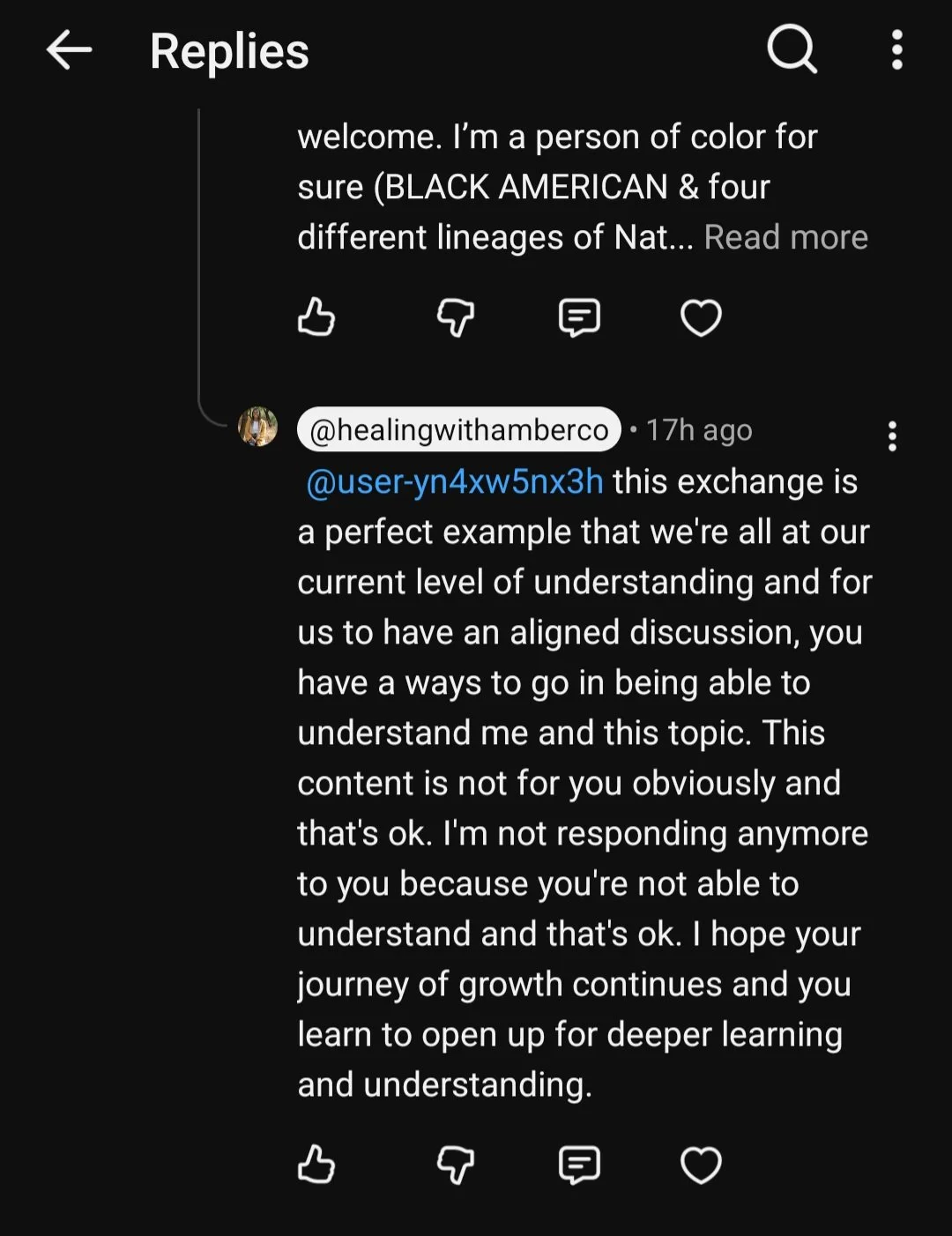
Most recent YouTube interaction on recent YouTube short
The Consciousness Shift Happening Right Now
I believe we’re living through a genuine shift in collective consciousness, and I don’t say that lightly or as a marketing phrase.
Across generations, across cultures, more and more folks are waking up to questions that previous generations either didn’t ask or weren’t safe to ask out loud. Questions about the systems they were raised inside and about what was inherited versus what was actually theirs, and questions about the relationship between spirituality and institution, between faith and fear, between what was taught as truth and what was actually a mechanism of control.
This shift isn’t comfortable because growth is never comfortable. Shifts in consciousness rarely are, for the individual or for the collective. When something this foundational starts to move, the systems built on top of it respond. I mean, look at America right now… right conversation, perhaps wrong time…. Sometimes that response looks like backlash or sometimes it looks like people you love feeling destabilized by your questions, even when your questions were never about them.
The backlash I receive isn’t really about me. It’s a small, local instance of a much larger friction. The friction of a worldview meeting something that doesn’t fit inside of it anymore. That doesn’t make the friction feel great to be on the receiving end of but it does change how I hold it.
Discernment as Spiritual Practice
Here is where I want to land here because I think this is the most useful thing I can offer on this topic.
Discernment, the capacity to sit with conflicting information, conflicting reactions, conflicting truths, and learn how to choose what is actually yours without needing everyone else to agree because it’s not a side skill. It’s one of the most important spiritual practices there is.
Discernment is what allows you to hear criticism and ask, honestly, is there something here for me, without collapsing into either total rejection or total absorption. It’s what allows you to know the difference between someone disagreeing with you and someone being a genuine messenger of something you need to hear, even when both arrive sounding similar.
Discernment is also what allows you to release content, relationships, or frameworks that aren’t for you without needing to convince anyone else that your choice is correct. You don’t owe an explanation for the edge you’re standing on. You don’t have to win the argument to know what’s true for you.
This is a spiritual intervention in its most practical form. Not a dramatic vision or a thunderclap of certainty, but the quiet, ongoing practice of checking in with your own knowing and trusting it, even when, especially when, the folks around you are telling you that you shouldn’t.
If You’re Ready to Go Deeper
If reading this landed somewhere real for you, if you’ve been feeling the friction of your own expanding understanding, of relationships and frameworks that no longer fit the way they used to, you don’t have to navigate that alone.
🌿 The Grief Sanctuary: Consider joining the reading space for women in exactly this kind of expansion. Monthly practices, ritual support, and a space where questioning is not a problem to be managed. Upgrade Subscription
Subscribe now
🛞 The Inner Circle: An exclusive tier for women who are ready for deeper, more personalized ongoing support as your understanding continues to shift. Upgrade Membership
Subscribe now
🔮 Spiritual Development Mentoring: A new offering for women who are ready to be guided through this expansion intentionally, with someone who has walked this edge and can hold both the clinical and the spiritual reality of what you’re moving through. This is one-on-one work for the woman who knows something is shifting and wants real support through it.
[Book a consultation at www.healingwithamber.co]
Remember that your understanding is allowed to expand and not everyone has to come with you at the same pace.
With care and intention,
Amber Choisella

The Clinician This Training Was Built For (And the One It Wasn’t)
Let me be specific about who this training is built for, because not every clinician needs it, and I would rather speak directly to the ones who do than cast a wide net and lose the people this is actually designed to serve. This training was built for a specific kind of practitioner. One I recognize because I was her.
Two People Reading This
This post is for both the clinician wondering whether this training is for them, and the grieving client who wants to understand what it would mean to work with a practitioner who has it.
Because the question of fit matters from both sides of the room.
Who the Training Was Built For
You are a licensed clinician, LPCC (LPC), LCSW, LMFT, psychologist, social worker, who works with grief in any form. Not only bereavement but also ambiguous loss, disenfranchised grief, identity loss, ancestral grief, and spiritual crisis related to grief. You understand that grief is not only about death and your practice already reflects that understanding.
You work with BIPOC/ BBIA (Black, Brown, Indigenous, and Asian) clients, or you want to. You’re either BIPOC/ BBIA yourself and navigate on how to bring your cultural and spiritual knowledge into your clinical work, or you are deeply committed to building a practice that doesn’t flatten your clients’ cultural and spiritual realities into a Western secular framework. You’ve felt the limitation of that flattening in the room and have watched clients edit themselves for it.
You’ve sat with a client’s spiritual experience, a visitation dream, a belief in ancestral communication, a ritual practice, a faith crisis, and felt genuinely unclear about your clinical role. Not uncomfortable in a way that would pathologize but felt genuinely uncertain of what to do next. You’ve wondered: do I engage this? How? What does culturally responsiveness actually look like in this specific moment, not just as a principle on a diversity training slide?
You’re spiritually curious or spiritually awakened yourself and may be navigating your own integration of clinical identity and spiritual identity, feeling like the two parts of you have been living in different rooms, and wondering if there is a way to let them meet in the work. You may have a practice, or beliefs, or a set of experiences you don’t bring into your clinical role because you’re trained not to and you’re starting to wonder what gets lost in that separation. What your clients lose when you perform a version of yourself that is less whole than the practitioner you actually are.
You want a framework. Not a vague set of principles or a checklist of culturally responsive behaviors, an actual framework, specific and grounded in both clinical and spiritual knowledge that you can actually use with your real clients in your actual practice.
If you read that and felt recognized, keep reading.
What This Training Is Not
You’re not the right fit if you are looking for a framework to use outside your clinical scope. This training assumes active licensure and is designed for practitioners working within a professional clinical context.
You’re not the right fit if you want a spiritual development experience for yourself. This is a clinical practitioner training, not personal growth work. You will likely gain personal insight, because that’s the nature of this material, but the primary focus is your clinical practice and what becomes possible in your room.
You’re not the right fit if you are looking for a passive CEU experience. This is an in-depth methodology training that requires genuine engagement with a live session that includes real application. It will ask something of you.
What the Right Clinician Usually Discovers
Something worth saying about what the right practitioner typically finds inside this training is…you already know more than you think you do.
You’ve been improvising your way through the gaps in your training for years. Reaching toward something more rigorous, sensing what your clients needed and not quite having the clinical language to hold it, doing the work with instinct and care, while being conscious of that constant low-grade awareness that your framework was not fully adequate to the complexity of what was in the room.
What the Psychospiritual Grief Method gives you is not entirely new knowledge. It’s a framework for the knowing you already have. Language for the things you’ve been sensing but didn’t have clinical permission to hold and structure for the work you’ve already been reaching toward.
That is what a good framework does. It doesn’t replace your instincts, no, instead it gives your instincts a home.
The practitioners most transformed by this training are not the ones who came in knowing the least. They’ll be the ones who came in carrying the fullest picture of their clients’ complexity, improvising through the gaps, and wanting something more rigorous to work from. They were already most of the way there. The framework named what they already knew and gave them a way to use it with intention.
What It Means If You’re the Client
If you are a grieving woman reading this, not a clinician, what this training exists to address is the gap you have felt in spaces that couldn’t hold your grief fully. The part of you that had to stay outside. The spiritual experiences you stopped mentioning because the room didn’t know how to hold them.
Practitioners trained in the Psychospiritual Grief Method have a framework for meeting the full complexity of your grief, ancestral, spiritual, somatic, and cultural without requiring you to translate yourself into a language that flattens it. This is what culturally responsive care looks like in practice, not as a principle but as a specific set of skills in the room with you.
You deserve a practitioner who has that framework and we do exist.
What the Training Includes
The Psychospiritual Grief Method training includes full instruction in the five-phase ARISE Arc as a usable clinical framework with specific tools for each phase. Clinical and spiritual frameworks for holding the intersection of grief, spirituality, and cultural identity, including continuing bonds, ancestral grief, spiritual crisis, and multigenerational loss. Case conceptualization tools and practitioner reflection practices. Live sessions for teaching, Q&A, and supervised application. A community container for practitioners working at this intersection, because the professional isolation of this work is real and worth addressing.
This methodology requires real learning, not passive content consumption.
Ready to Learn More?
For clinicians: Enrollment for the Psychospiritual Grief Method Training is open now. Six CEUs. Small cohort. Built for practitioners who are ready to bring their whole self into the room. [Full details at www.healingwithamber.co/the-psychospiritual-grief-method]
For clients: If you are navigating grief that has a spiritual or ancestral dimension and you want one-on-one support from a practitioner who holds both, a free consultation is available. [Book at www.healingwithamber.co]
This framework doesn’t replace your instincts. It gives your instincts a home.
Amber
Your Spiritual Gifts Are Terrifying You and That’s Exactly How They’re Supposed to Arrive
What Your Ancestors Want You to Know About the Power You’re Afraid to Claim
You felt something you weren’t supposed to be able to feel. You knew something before it was possible to know it. You saw something in a dream that then happened. You sensed a presence so clearly that the rational explanation stopped being convincing, and the one that replaced it scared you more.
Your first instinct wasn’t wonder. It was fear.
That response is not a sign that something is wrong with you. It is, in fact, one of the most reliable indicators that something real is happening.
Why Emerging Gifts Feel Terrifying
Spiritual gifts, when they’re emerging, don’t usually arrive with a soft welcome or a clear instruction manual. They arrive in the gap between what you thought was real and what you’re suddenly experiencing. They land in the nervous system before the mind has a framework to receive them, which means the nervous system often responds the way it responds to any unknown, with alarm.
The gift doesn’t feel like a gift when it first arrives. It feels like something happening to you without your permission kinda like a curse… It can and does feel like that at time because you start seeing things you didn’t ask to see and knowing things you didn’t ask to know. You’re being affected by other people’s emotional states so acutely that you can barely distinguish/discern their pain from your own. You could also be receiving information in dreams or in waking moments that turns out to be accurate in ways you can’t explain.
These experiences are disorienting. The disorientation is not evidence that you are broken. It is evidence that your capacity is larger than the container you’ve been living inside, and that the container is in the process of expanding.
Fear Versus Reverence
There is an important distinction worth making here, between the fear that signals danger and the fear that signals the sacred.
Not all fear is a warning to retreat. Some fear is the body’s way of recognizing that something significant is happening, something that asks for a different quality of attention than ordinary experience requires. Many spiritual traditions same the belief that the shaking in the presence of something holy is not the same as the shaking in the presence of something threatening, even when both feel like fear in the body.
The fear that says “I am in danger” is usually accompanied by a desire to flee, to close, to protect. The reverence that looks like fear is often accompanied by something underneath it that wants to move closer, even when the surface of you is frightened. The awe that is on the other side of the alarm.
Learning to tell the difference is part of the work of living in relationship with gifts that are larger than you initially knew how to hold. You don’t have to be fearless. You just have to be willing to get curious about what the fear is actually pointing toward.
What Was Taken, What Is Being Reclaimed
For BIPOC people, the terror around spiritual gifts carries a layer that is worth naming directly.
Your ancestors had these gifts. The woman in your lineage who was called a healer, a dreamer, a medicine woman, a seer and the traditions your people practiced before colonization, before forced conversion, before the calculated destruction of Indigenous spiritual systems and the criminalization of African and Afro-Caribbean religious practice. The gifts that existed in your bloodline for generations before they became dangerous to express.
Suppression isn’t ancient history. The Yoruba religion was actively persecuted across multiple continents well into the twentieth century. Curanderismo and Indigenous ceremonial practice were interrupted through residential schools and forced assimilation within living memory. The “Strong Black Woman” framework that forbids vulnerability also, conveniently, forbids the kind of softness and receptivity that gifts require.
What you’re experiencing as terrifying might be, in part, a cellular memory of the cost of these gifts. Your nervous system holds the history of what happened when the women before you were seen with these abilities. The fear is not only yours, but some of it is also inherited and inheriting it does not mean you are required to stay inside it.
These gifts weren’t destroyed by suppression because they went underground. They moved through the bloodline in forms that were harder to name and easier to survive with. They are surfacing now in you, in part because you are living in conditions where it is finally safe enough to surface.
Common Experiences That Terrify People
If you are wondering whether what you’re experiencing counts, here is what I hear most often from the women who find their way to this work:
Knowing something about a person the first time you meet them, information you had no logical way of accessing.
Feeling other people’s emotions in your own body with such acuity that crowds become overwhelming and some people leave you depleted in ways that have nothing to do with what was said.
Dreams that contain specific, accurate information about things that then happen.
A sense of presence in rooms that feels distinct from imagination.
Hearing a name, a word, or a phrase clearly in the space between sleeping and waking.
A sudden and inexplicable knowing about a situation or a person that turns out to be true.
These are'’t symptoms. They’re capacities and that distinction matters.
Why the Gifts Are Emerging Now
Grief is one of the primary activating conditions for spiritual gifts. This is not coincidence or poetic metaphor. The experience of profound loss disrupts the ordinary psychological and nervous system structures that keep certain kinds of perception filtered out. When the container of the normal life cracks open, what was being filtered sometimes comes through.
Tower moments do the same thing. Identity crisis, spiritual awakening, the loss of the structures you organized your life around, these are all conditions that open the veil in both directions. You become more permeable and the information that was always there but was previously blocked by the business of ordinary life begins to come through.
Your ancestors may also have made a choice. There are traditions across multiple cultures that understand spiritual gifts as something transmitted with intention from the lineage, often to a specific person, often at a specific moment in their life. If you are the one in your family who is doing the conscious work, who is naming what was unnamed, who is in the passage of transformation, you may be the one the lineage chose to transmit through. That is an enormous thing to receive. It is also, from the ancestral perspective, a form of trust.
What to Do When the Gifts Terrify You
The first and most important instruction is this: don’t shut it down.
Suppression does not make gifts disappear. It makes them louder and less organized. What does not flow finds other channels, and those channels are usually less comfortable than the one you were trying to avoid. Fear is understandable but I’m gonna tell you right now that suppression is NOT the answer to it.
Learn to ground before and after any experience of heightened perception. Intentionally place your feet on the floor and allow your body to make physical contact with something solid. Take slow and deliberate breaths. Grounding creates the container that makes the gifts navigable rather than overwhelming.
Find language for what you’re experiencing, if not with everyone in your life, then in a journal, in a community that understands, with a practitioner who can hold the full picture. The gifts become more workable when you stop having to pretend they aren’t happening.
Study what you’re experiencing within a tradition or framework that has held this before. You don’t have to invent the language from scratch. The traditions your lineage came from have language for this. Finding your way back to that language can be its own form of homecoming.
When to Seek Support
If your experiences are interfering with your ability to function, care for yourself, maintain basic safety, or stay connected to reality in ways that feel frightening rather than expansive, please reach out for support from someone trained to hold both the clinical and the spiritual dimensions, like me. A genuine spiritual emergency may need both a skilled spiritual guide and a clinical practitioner, and there is no spiritual integrity in refusing support when support is what the moment requires.
If your experiences are disorienting but you are functional, you are safe, and something underneath the fear recognizes what is happening even while the surface is frightened, what you likely need is not clinical intervention but spiritual accompaniment. Someone who can help you learn to live inside the expanded capacity rather than fight it, like me.
What Your Ancestors Want You to Know
I have been doing this work long enough to tell you, with confidence, what comes through again and again when I sit with women in exactly this experience:
They gave you these gifts because they trust you. Not because it will be easy, or because you won’t be frightened, or because you have your life perfectly arranged to receive them. They trust you because they’ve been watching you, they know what you’re capable of, they know that gifts emerging isn’t separate from the grief and loss you’ve been moving through. The Tower happened because they needed you open. The grief did what grief does because they needed you permeable. Your gifts are arriving now because now is when you can finally hold them.
You’re not going crazy. You’re coming into something and you are not alone in it.
You Don’t Have to Figure This Out Alone
📞 Schedule a spiritual consultation with Amber. If you are in the middle of an emerging gift and you need someone who can hold both the clinical and the spiritual reality of what you’re experiencing, a one-on-one consultation is where that conversation happens. This is where we assess what is unfolding, what kind of support would actually serve you, and how to begin building a relationship with what is emerging rather than fighting it. Available worldwide for spiritual consultation. [Book at www.healingwithamber.co]
Your gifts are real. You were chosen for them for purpose. Come find the support that helps you receive them.
With love,
Amber Choisella

What Psychospiritual Grief Work Actually Looks Like (Why It's Not Just Therapy OR Spirituality)
It All Begins Here
When I tell people I do “psychospiritual grief work,” they usually look confused.
“So like... therapy?” they ask. “Or like... spiritual counseling?” they ask next. The answer is neither and both. And that confusion is exactly why so many people’s grief stays stuck.
Here’s the truth: grief is not just a psychological problem that therapy can solve and it’s not just a spiritual crisis that spirituality can heal. It’s both, simultaneously, integrated into one whole human experience. Until you address BOTH dimensions, you’re only getting half the healing.
What Psychospiritual Grief Work Means
Psychospiritual grief work is the integration of clinical psychology, spiritual wisdom, somatic practice, and cultural understanding into one coherent approach to loss.
It means:
You don’t have to choose between your therapist and your medium. You don’t have to hide your spiritual experiences from your therapist because they’ll pathologize them. You don’t have to pretend your grief is only about brain chemistry and neurotransmitters when you KNOW your person is trying to reach you. And you don’t have to bypass your trauma by throwing spiritual platitudes at legitimate psychological pain.
Psychospiritual work holds both realities at once:
Your grief is real AND your loved one is still connected to you
Your trauma needs processing AND your ancestors are supporting your healing
Your nervous system needs regulation AND your spiritual gifts are opening
You need clinical support AND you need ancestral wisdom
Your pain is legitimate AND it’s transforming you
What It Actually Looks Like in Practice
Session 1: The Foundation
We start where traditional therapy does. We focus on understanding your loss, your history, what broke when they died (or left, or changed). I’m asking clinical questions: What’s your support system? Are you sleeping? Have you had thoughts of harming yourself? What were your attachment patterns?
I’m also asking the questions therapy won’t: What spiritual experiences are you having that you’re afraid to mention? What signs have you noticed? Do you feel their presence? What does your intuition tell you about them? Are you seeing them in dreams? What cultural or ancestral practices around grief do you come from?
Clinical + Spiritual from minute one.
The Body Work
Traditional grief therapy might talk about “somatic responses to trauma” which is good…. but psychospiritual work says: your body is a sacred text. The tightness in your chest isn’t just stress. It’s where you’re holding unexpressed words to your person. The exhaustion isn’t just depression. It’s your nervous system working overtime to process both the physical loss AND the spiritual reality of their continued presence.
We work somatically: breathwork, body scans, gentle movement. We locate the grief in your body and ask what it needs. And we do this while honoring that grief lives in the body because humans are WHOLE beings not just minds, not just spirits, but integrated systems.
The Spiritual Processing
This is where psychospiritual work differs most from traditional therapy. We’re not bypassing your grief by telling you “they’re in a better place.” We’re not spiritually gaslighting you. Instead, we’re creating space for the spiritual reality of your loss.
If you’re having mediumship experiences such as receiving messages, signs, and/or dreams, we will be exploring that. Not as “coping mechanisms” (the psychology term that dismisses it) but as actual communication. We’re asking: what is your person trying to tell you? What do they want you to know? What unfinished business exists?
We’re also asking the clinical question: is this helping your grief or prolonging it? Are these experiences grounding you or keeping you in fantasy? Are they connecting you to your person in a healthy way, or are they keeping you stuck?
Integration, not separation.
The Cultural Layer
Psychospiritual grief work MUST include cultural understanding. Your grief isn’t generic. If you’re a Black woman, your grief carries the weight of systemic racism, medical racism, the loss of your people. If you’re Latinx, your grief includes the family dynamics and cultural expectations you grew up with. If you’re Indigenous, your grief might be collective, for your people, your land, your ancestors’ suffering.
Traditional therapy often ignores this. Spirituality sometimes appropriates it. Psychospiritual work centers it.
We’re asking: What does your culture teach about grief?What rituals belong to your people? What ancestral wisdom do you have access to? How does your identity as a BIPOC woman shape your grief? What systemic oppression is layered into this loss? What do your ancestors need from you in this grief?
The Integration Work
This is the deepest part. Once we’ve addressed the psychology, the somatic, the spiritual, and the cultural dimensions, we integrate them.
You’re not “getting over” your grief. You’re learning to carry it while also carrying joy. You’re not “moving on.” You’re weaving your person into the fabric of who you’re becoming. You’re not “healing” as if the wound closes and disappears. You’re integrating the loss into your identity in a way that honors both the person you were before and the person you’re becoming.
Psychospiritual integration means:
You can cry about their death AND feel their presence
You can be angry at God/Universe/Spirit AND believe in ancestral support
You can use clinical tools AND spiritual practices
You can process trauma AND receive messages
You can grieve who you were AND embrace who you’re becoming
You can honor your culture AND integrate modern psychological understanding
You can believe in both evidence-based therapy AND the reality of spirit
Why This Matters
Too many BIPOC women are sitting in therapy with white therapists who dismiss their spiritual experiences as symptoms of depression. Too many are working with spiritual teachers who tell them to “trust the universe” while ignoring legitimate trauma. Too many are trying to choose between their psychology and their spirituality when the answer is: you need both.
Grief work that only addresses the mind leaves the Spirit orphaned. Grief work that only addresses the spirit leaves the trauma unprocessed. Psychospiritual grief work says you’re a whole person deserving of whole care.
This is the work I do. This is the work I teach other clinicians to do and this is what changes everything.
How to Access Psychospiritual Grief Work
If you’re grieving and you’ve been stuck in either “just therapy” or “just spirituality,” you deserve this integrated approach.
Three ways to work with me:
🌙 Join The Grief Sanctuary My membership community where we do psychospiritual grief work together. Monthly ancestral rituals, weekly spiritual counseling, group mediumship sessions, and community of BIPOC women who understand the full complexity of grief. $27/month gets you everything—live calls, practices, recordings, resource library.
💙 Free Grief Therapy Consultation If you want to explore whether working together is right for you, book a free 15-minute consultation. We’ll talk about what brought you here, what you’ve tried, what you’re hoping for. No obligation. Just honest conversation.
[Schedule Your Free Consultation]
🔮 For Clinicians: The Psychospiritual Grief Method Training If you’re a therapist, counselor, or licensed clinician who wants to learn how to integrate spiritual wisdom with clinical psychology in grief work, I’m launching certification training on July 25th, 2026.
This is for clinicians who are tired of the limitations of Western psychology alone. Who understand that your BIPOC clients are having spiritual experiences you have no framework for. Who want to expand your practice to honor the whole person: mind, body, spirit, & culture.
The training covers:
The five transformation phases of psychospiritual grief (Acknowledge, Embody, Reconnect, Integrate, Transform)
How to create culturally-responsive containers for grief work
Integrating mediumship, tarot, ancestral practice, somatic work, and trauma processing
Working ethically at the intersection of therapy and spirituality
Building a sustainable practice that honors your own energy
[Learn More About The Psychospiritual Grief Method Training]
You Deserve the Whole Thing
Your grief doesn’t fit into a single box. Your healing doesn’t need to choose between psychology and spirituality. You’re a whole person deserving of whole care.
Psychospiritual grief work isn’t a trend or a luxury. It’s the integration you’ve been waiting for.
Whether you join Sanctuary, book a consultation, or train to offer this work yourself, there’s a space for you here.
Your grief matters. Your spirit matters. Your culture matters. All of it, together.
With care + intention,
Amber